You're studying behavior, and that means understanding how people develop and learn. Unit 3 is where it all comes together—from how you thought as a kid to why you do what you do now. This unit covers two major areas: how you develop physically, cognitively, and emotionally across your entire life, and the fundamental learning principles that explain why you act the way you do.
Let's break down Unit 3 so you can crush this section of the AP exam.
🎯 What You Need to Know for the Exam
Unit 3 makes up about 15-25% of the AP Psychology exam. Focus your energy on these priorities:
Piaget's stages explain how children's thinking changes fundamentally, not just accumulates information.
Attachment and parenting styles in early development have lasting effects on social and emotional outcomes.
Classical and operant conditioning are two different mechanisms that explain how behavior is learned.
Reinforcement and punishment are defined by their effect on behavior, not by how they feel (positive/negative means adding/removing).
People learn through observation and insight too—conditioning doesn't explain everything about learning.
Development is shaped by both nature and nurture interacting together, not one or the other.
Topic 3.1: Themes and Methods in Developmental Psychology
Developmental psychology looks at how people change over time. But before you dive into the specifics of development, you need to understand the big-picture questions that shape this entire field.
What This Topic Covers: Developmental psychologists constantly debate four major themes. These themes shape how researchers design studies and interpret what they find. You'll see these ideas pop up everywhere in Unit 3, so nail them now.
Key concepts to know:
Stability vs. Change - Do your personality and abilities stay the same throughout life, or do they keep changing? The answer is usually both. Some traits like temperament are pretty stable, but others like intelligence and personality can shift with experience.
Nature vs. Nurture - Are you the way you are because of your genes or your environment? Spoiler: it's almost always both interacting together. This debate shows up in cognitive development, personality, and even learning abilities.
Continuous vs. Discontinuous Development - Does development happen gradually (like filling a glass with water) or in stages (like climbing stairs)? Some things develop smoothly; others happen in distinct stages.
Cross-sectional vs. Longitudinal Research - Cross-sectional studies compare different age groups at one point in time (fast and cheap, but confounded by generational differences). Longitudinal studies follow the same people over time (expensive and slow, but way more reliable for tracking change).
⚠ Watch out for:
Students sometimes think "longitudinal" is always better. It usually is for tracking development, but it has real problems—people drop out, times change, and it takes forever. Exam questions might ask why researchers choose one method over the other.
🧪 Practice with StarSpark
🃏 Flashcards · 15 cards
Topic
AP Psych: Developmental Themes and Research Methods
Focus on
Stability vs. change, nature vs. nurture, continuous vs. discontinuous development, cross-sectional vs. longitudinal methods
📝 Quiz · 10 questions
Topic
AP Psych: Developmental Themes and Research Methods
Description
Identify research designs (cross-sectional vs. longitudinal), classify examples as nature vs. nurture, continuous vs. discontinuous
Try these in StarSpark → Flashcards or New Assignment
Topic 3.2: Physical Development Across the Lifespan
Your body changes constantly from conception to old age. This topic is packed with specific facts the exam loves to test.
What This Topic Covers: Physical development starts before you're born and continues until you die. You need to know what affects development, what your body can do at different ages, and how your brain and senses change.
Key concepts to know:
Teratogens - These are environmental factors that damage fetal development. Alcohol, certain drugs, infections, and radiation are classic teratogens. The first trimester is especially critical because that's when major organ systems are forming.
Reflexes and Motor Development - Newborns come with built-in reflexes like rooting, grasping, and the startle reflex. Motor development follows a pretty predictable sequence (head control, then sitting, then crawling, then walking). Not all babies crawl, but they hit these milestones in roughly the same order.
Puberty - Hormones trigger massive physical and psychological changes. It starts earlier than you might think (sometimes age 8 for girls, 10 for boys) and continues into your mid-twenties. Don't just memorize that it happens—understand that timing varies a lot between individuals.
Aging - Your senses decline, reaction time slows, and physical strength decreases. But here's what's important: cognitive decline isn't automatic. People who stay mentally and physically active age better cognitively.
The Visual Cliff - This famous study by Eleanor Gibson showed that even crawling babies have depth perception and are afraid of falling. It demonstrates that some perceptual abilities develop relatively early.
⚠ Watch out for:
Confusing which reflexes disappear at which ages. The exam might give you a baby and ask which reflexes should still be present. Know that primitive reflexes fade, but postural reflexes stick around.
🧪 Practice with StarSpark
🃏 Flashcards · 20 cards
Topic
AP Psych: Physical Development
Focus on
Teratogens, motor development milestones, reflexes in newborns and infants, puberty, aging and sensory decline
📝 Quiz · 15 questions
Topic
AP Psych: Physical Development
Description
Identify effects of teratogens, match motor milestones to ages, explain how physical changes affect behavior and learning
Try these in StarSpark → Flashcards or New Assignment
Topic 3.3: Gender and Sexual Orientation
This topic covers how gender identity develops and how social factors shape it.
What This Topic Covers: You're learning the difference between sex (biological) and gender (social and psychological). You'll explore how socialization influences gender behavior, and how sexual orientation develops.
Key concepts to know:
Sex vs. Gender - Sex is about chromosomes, hormones, and anatomy. Gender is how you identify and the roles society assigns. They're related but not the same thing.
Gender Socialization - From birth, society sends messages about how boys and girls "should" behave. Parents, peers, media, and schools all reinforce these messages. Research shows that both nature and nurture shape gender behavior.
Sexual Orientation - This is your romantic and sexual attraction to others. It exists on a spectrum and appears to have both biological and environmental influences. The timing of development and the role of social factors are still being researched.
Stereotype Threat - When people are aware of negative stereotypes about their group, their performance can suffer. This affects learning and test-taking, which is why context matters when you're developing.
⚠ Watch out for:
Making assumptions about cause and effect. The exam will show you research findings, but correlation isn't causation. A study showing gender differences in behavior doesn't tell you whether those differences came from biology, socialization, or both.
🧪 Practice with StarSpark
🃏 Flashcards · 15 cards
Topic
AP Psych: Gender and Sexual Orientation Development
Focus on
Sex vs. gender, gender socialization, sexual orientation, stereotype threat and its effects
📝 Quiz · 10 questions
Topic
AP Psych: Gender and Sexual Orientation Development
Description
Distinguish nature and nurture in gender, analyze socialization effects, explain stereotype threat scenarios
Try these in StarSpark → Flashcards or New Assignment
Topic 3.4: Cognitive Development
This is one of the biggest topics in Unit 3. Piaget's theory dominates here, but you also need to know Vygotsky and intelligence concepts.
What This Topic Covers: How does your thinking change from infancy to adulthood? Piaget proposed that children move through distinct stages where their thinking fundamentally changes. We'll also look at how culture and language shape thinking, and how intelligence and memory work across your lifespan.
Key concepts to know:
Piaget's Stages of Cognitive Development:
Sensorimotor (0-2 years) - Babies learn through senses and movement. Object permanence (understanding that things exist even when you can't see them) develops here. A baby thinks the toy really is gone when you hide it, then gradually realizes it's still there.
Preoperational (2-7 years) - Kids can think symbolically (using words and images) but not logically. Egocentrism is huge here. Kids genuinely can't see the world from another person's perspective. Animism is common too. They believe inanimate objects have feelings and intentions (like thinking a stuffed animal gets sad). They also struggle with conservation. They think that spreading out coins makes them more money, or pouring juice into a different glass changes the amount.
Concrete Operational (7-11 years) - Kids can now think logically about concrete things. They understand conservation, can reverse their thinking, and can organize objects into categories. But they still struggle with abstract ideas.
Formal Operational (11+ years) - Teenagers and adults can think abstractly, form hypotheses, and think through combinations and possibilities. They can now understand metaphors, debate ideas, and think about "what if" scenarios.
Image: OpenStax Psychology 2e (CC BY 4.0)
Vygotsky's Zone of Proximal Development (ZPD) - This is the gap between what you can do alone and what you can do with help. A good teacher or tutor works in this zone, offering scaffolding—support that gradually gets removed as you improve. This is way more culturally flexible than Piaget and emphasizes that learning is social.
Crystallized vs. Fluid Intelligence - Fluid intelligence is your raw problem-solving ability and processing speed. It peaks in your 20s and declines with age. Crystallized intelligence is knowledge and skills you've accumulated. It stays stable or even improves with age. Older people often have greater crystallized intelligence, which is why experience matters.
Cognitive Changes in Aging - Processing speed slows and working memory declines. But if you stay mentally active, semantic memory (facts and knowledge) actually holds up better than episodic memory (personal experiences). Dementia is not a normal part of aging—it's a disease.
⚠ Watch out for:
Thinking that Piaget's stages are locked in stone. Kids sometimes show concrete operational thinking at age 5 and preoperational thinking at age 9 depending on the task. Also, not everyone reaches formal operational thinking reliably—this matters for understanding adolescent behavior.
🧪 Practice with StarSpark
🃏 Flashcards · 25 cards
Topic
AP Psych: Piaget's Cognitive Development Theory
Focus on
Piaget's four stages with age ranges and characteristics, conservation, egocentrism, object permanence, Vygotsky's ZPD, fluid vs. crystallized intelligence
📝 Quiz · 15 questions
Topic
AP Psych: Piaget's Cognitive Development Theory
Description
Match children's behaviors to Piaget stages, identify cognitive abilities at each stage, explain conservation and egocentrism
Try these in StarSpark → Flashcards or New Assignment
Topic 3.5: Communication and Language Development
Language is one of your most important abilities. This topic covers how you learn to understand and produce language, and the critical periods where this learning happens most easily.
What This Topic Covers: You're learning the building blocks of language and how children acquire language. You'll also learn about language's limits—there may be critical periods when language learning is easiest, and learning language shapes how you think.
Key concepts to know:
Phonemes and Morphemes - Phonemes are the smallest sounds in a language (like the "p" sound in "cat"). Morphemes are the smallest units of meaning (like "cat" or "un-" or "-ed"). You need to produce the right sounds and combine them into meaningful units.
Semantics and Syntax - Semantics is the meaning of words. Syntax is the rules for combining words into sentences. "Dog bites man" and "Man bites dog" have the same words but different meanings because syntax matters.
Language Acquisition - Babies start with cooing and babbling, then one-word utterances, then two-word combinations, then increasingly complex sentences. The order is pretty consistent across languages.
Overregularization - Kids learn language rules and then overapply them. A kid says "I goed" or "two foots" because they've learned the rules and are using them systematically. This is actually a sign of language development, not a mistake.
Critical Periods - There seems to be a critical period for language acquisition, probably until puberty. Kids who learn language during this window learn it more easily than adults do. The case of Genie (a girl raised in isolation) showed that language development really does matter early on.
⚠ Watch out for:
Confusing language production with language comprehension. Babies understand language before they can produce it. Also, the idea of critical periods doesn't mean you can't learn language as an adult—just that it's harder and takes longer.
🧪 Practice with StarSpark
🃏 Flashcards · 15 cards
Topic
AP Psych: Language Development and Communication
Focus on
Phonemes, morphemes, semantics, syntax, language acquisition stages, overregularization, critical periods
📝 Quiz · 10 questions
Topic
AP Psych: Language Development and Communication
Description
Identify language components, match acquisition stages to ages, explain overregularization and critical periods
Try these in StarSpark → Flashcards or New Assignment
Topic 3.6: Social-Emotional Development
How do you learn to relate to other people and understand yourself? This topic covers attachment, personality, parenting styles, and identity.
What This Topic Covers: You start life completely dependent on other people. You form attachments that shape how you relate to others throughout life. Your temperament and personality emerge early, and your parents' style shapes how you develop socially and emotionally.
Key concepts to know:
Attachment - You form emotional bonds with caregivers, usually starting around 6-8 months. Secure attachment means you trust your caregiver will be there when you need them. Insecure attachment (avoidant, resistant, or disorganized) develops when caregivers are unreliable or unresponsive. Harlow's famous study with rhesus monkeys showed that comfort and contact matter way more than food in forming attachment.
Image: OpenStax Psychology 2e (CC BY 4.0)
Temperament - Your basic emotional and behavioral style appears pretty early and is fairly stable over time. Some babies are easygoing, some are slow-to-warm-up, and some are difficult. This isn't parenting's fault—it's built-in.
Parenting Styles - Diana Baumrind identified three main styles. Authoritative parents are warm and set clear limits (this tends to produce the best outcomes). Authoritarian parents are strict and cold. Permissive parents are warm but set few limits. Keep in mind these are generalizations, and culture shapes what "good parenting" looks like.
Identity Formation - Erik Erikson described identity development as a lifelong process with different tasks at different ages. Erikson's adolescent stage (identity vs. role confusion) is about figuring out who you are. James Marcia later described identity statuses: diffusion (no exploration, no commitment), foreclosure (commitment without exploration), moratorium (exploration without commitment yet), and achievement (exploration followed by commitment).
⚠ Watch out for:
Assuming that parenting style completely determines outcomes. Kids are resilient and bring their own temperament to the mix. Also, remember that culture matters—authoritative parenting is valued in individualistic Western societies, but different cultures prioritize different parenting approaches.
🧪 Practice with StarSpark
🃏 Flashcards · 20 cards
Topic
AP Psych: Social-Emotional Development
Focus on
Attachment theory and types, temperament, parenting styles (authoritative, authoritarian, permissive), Erikson's theory, identity statuses
📝 Quiz · 15 questions
Topic
AP Psych: Social-Emotional Development
Description
Classify attachment types from scenarios, match outcomes to parenting styles, identify identity statuses and Erikson's stages
Try these in StarSpark → Flashcards or New Assignment
Topic 3.7: Classical Conditioning
This is where learning principles really start. Classical conditioning explains how you learn to associate one thing with another.
What This Topic Covers: Ivan Pavlov's dogs are the classic example, but classical conditioning is happening around you constantly. You're learning what topics covered in this section.
Key concepts to know:
The Elements of Classical Conditioning:
Unconditioned Stimulus (UCS) - Something that naturally triggers a response without learning. Food is a UCS that makes dogs salivate.
Unconditioned Response (UCR) - The automatic response to the UCS. Salivation is the UCR.
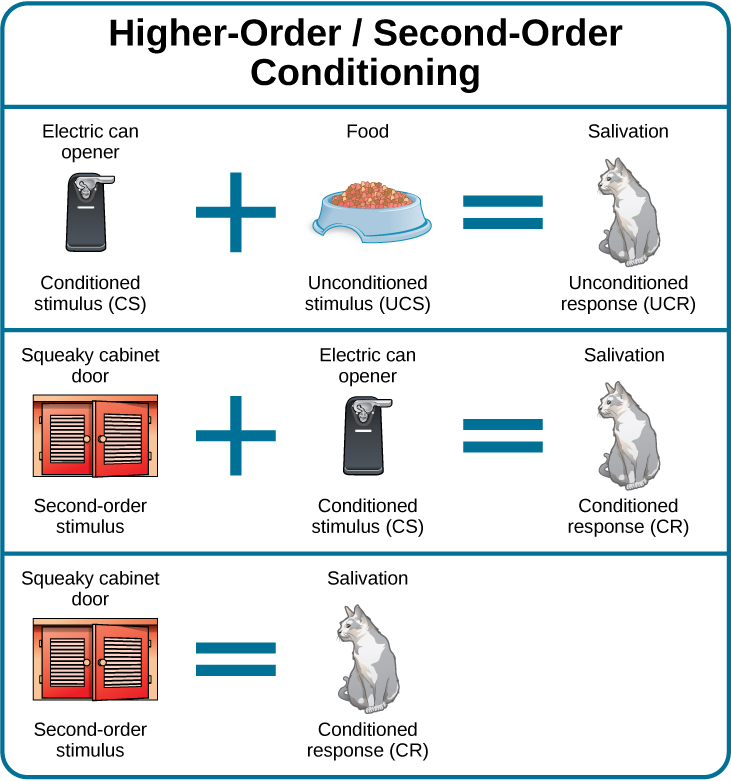
Conditioned Stimulus (CS) - A neutral stimulus that becomes associated with the UCS. Pavlov's bell is a CS.
Conditioned Response (CR) - The learned response to the CS. The dog's salivation to the bell is a CR.
Image: OpenStax Psychology 2e (CC BY 4.0)
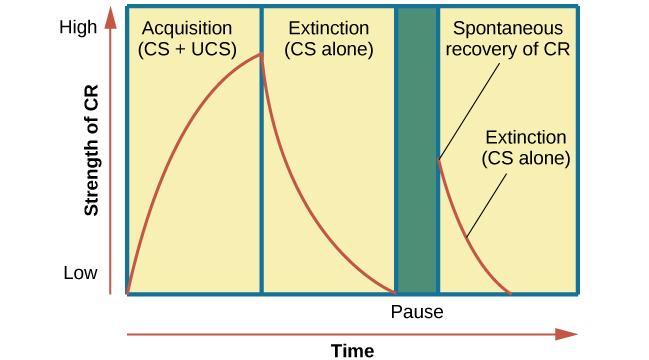
Acquisition - The process of learning the association between CS and UCS. This happens faster if the CS comes right before the UCS (good timing matters).
Extinction and Spontaneous Recovery - If you present the CS without the UCS repeatedly, the CR weakens (extinction). But it can come back on its own later (spontaneous recovery) if you present the CS again.
Stimulus Generalization and Discrimination - You might fear dogs after a bad experience with one dog. That's generalization—the fear spreads to similar stimuli. But you can learn to discriminate—to fear one dog but not others that look different.
⚠ Watch out for:
Confusing extinction with "unlearning." The learning isn't erased; it's inhibited. That's why spontaneous recovery happens. Also, don't mix up generalization and discrimination—they're opposite processes.
Identify UCS, UCR, CS, CR in scenarios, explain acquisition and extinction, distinguish generalization from discrimination
Try these in StarSpark → Flashcards or New Assignment
Topic 3.8: Operant Conditioning
Classical conditioning works when you pair stimuli. Operant conditioning works when you apply consequences to behavior. This is how people learn to do things intentionally.
What This Topic Covers: B.F. Skinner showed that behavior is shaped by its consequences. If something good happens after you do something, you're more likely to do it again. If something bad happens, you're less likely to do it. Learning the difference between reinforcement and punishment, and between positive and negative, will save you on the exam.
Key concepts to know:
Reinforcement (Increases Behavior):
Positive Reinforcement - You add something good after behavior. Study hard, get good grades. Your parents give you praise for cleaning your room. The addition of something desirable increases the behavior.
Negative Reinforcement - You remove something bad after behavior. Wear a seatbelt and the annoying beeping stops. This increases behavior because it removes an unpleasant thing. (Don't confuse this with punishment—negative reinforcement actually increases behavior.)
Punishment (Decreases Behavior):
Positive Punishment - You add something bad after behavior. Get a speeding ticket for speeding. Grounding removes privileges. Something unpleasant is added, which decreases behavior.
Negative Punishment - You remove something good after behavior. Take away your phone for breaking curfew. Remove screen time for not finishing homework. Something pleasant is removed, which decreases behavior.
Shaping - You can't always wait for the exact behavior you want. Shaping involves reinforcing closer and closer approximations of the desired behavior. Training animals this way is classic, but it works for teaching people skills too.
Schedules of Reinforcement - How often you reinforce behavior changes how strong the behavior becomes and how fast it extinguishes:
Fixed Ratio (FR) - Reinforce after a set number of responses. Video game loot after every 10 kills. Creates fast, steady responding.
Variable Ratio (VR) - Reinforce after an unpredictable number of responses. Slot machines and lottery tickets. This creates the fastest, most persistent responding. People keep going because the next one might pay off.
Fixed Interval (FI) - Reinforce the first response after a set time. Paycheck every two weeks. Creates slow responding at first, then faster responding as the time approaches.
Variable Interval (VI) - Reinforce the first response after an unpredictable time. Checking your phone for texts. Creates steady, persistent responding.
Image: OpenStax Psychology 2e (CC BY 4.0)
⚠ Watch out for:
The positive/negative distinction trips up a lot of students. Positive means something is added; negative means something is removed. Both can increase behavior (reinforcement) or decrease it (punishment). The key is the effect on behavior, not whether it feels good.
🧪 Practice with StarSpark
🃏 Flashcards · 25 cards
Topic
AP Psych: Operant Conditioning
Focus on
Positive and negative reinforcement, positive and negative punishment, shaping, fixed ratio, variable ratio, fixed interval, variable interval schedules
📝 Quiz · 20 questions
Topic
AP Psych: Operant Conditioning
Description
Classify reinforcement vs. punishment scenarios, identify positive vs. negative, match schedules to behavior patterns, explain shaping
Try these in StarSpark → Flashcards or New Assignment
Topic 3.9: Social, Cognitive, and Neurological Factors in Learning
Classical and operant conditioning explain a lot, but they don't explain everything. People learn through observation, insight, and latent learning too.
What This Topic Covers: You can learn by watching other people and imitating them. You can have sudden insights where you understand something new. You can learn things without any obvious reinforcement and use that learning later. This topic covers the limits of basic conditioning and the bigger picture of how people really learn.
Key concepts to know:
Observational Learning (Modeling) - You learn by watching other people and imitating them. Albert Bandura's famous Bobo doll experiment showed that kids who watched an adult punch and kick a doll were more aggressive with it themselves. No direct reinforcement happened to the kids—they just watched and learned. Media matters here: kids who watch aggressive behavior become more aggressive.
Image: OpenStax Psychology 2e (CC BY 4.0)
Latent Learning - You can learn things without showing you've learned them yet. Tolman's rats learned a maze layout just by exploring it, even though they got no rewards. When food was finally placed in the maze, they solved it immediately. They had been learning all along; they just weren't showing it.
Insight Learning - You suddenly understand how to solve a problem or see a solution clearly. The "aha moment" is insight learning. Köhler's chimps learned to use sticks as tools to get bananas—they didn't learn through trial and error, they figured it out.
Biological Constraints on Learning - Organisms are predisposed to learn some things more easily than others. Rats easily learn to avoid poison taste (even if it makes them sick hours later) but struggle to learn that taste causes electric shock. They're biologically prepared to connect taste with illness.
Cognitive Maps - Your brain isn't just storing individual behaviors or associations. You're building mental maps of your environment and understanding. You know where your classroom is relative to the cafeteria without consciously mapping it out.
⚠ Watch out for:
Thinking that observational learning requires imitation to happen immediately. Bandura showed that people learn from observation and might show the behavior later when circumstances are right. Also, recognize that all three types of learning (classical conditioning, operant conditioning, and observational) are real and important.
🧪 Practice with StarSpark
🃏 Flashcards · 15 cards
Topic
AP Psych: Observational Learning and Cognitive Factors
Focus on
Observational learning and Bandura's experiments, latent learning, insight learning, biological constraints on learning, cognitive maps
📝 Quiz · 15 questions
Topic
AP Psych: Observational Learning and Cognitive Factors
Description
Explain observational learning examples, contrast with classical and operant conditioning, identify latent and insight learning scenarios
Try these in StarSpark → Flashcards or New Assignment
Study Tips for Unit 3
Unit 3 is vast because it covers the entire lifespan and three different learning mechanisms. Here's how to approach it strategically:
Split development and learning: The development topics (3.1-3.6) focus on how people change over time. The learning topics (3.7-3.9) focus on mechanisms that explain behavior. Study them separately even though they're in the same unit.
Know Piaget inside and out: Piaget shows up constantly on the AP exam. Memorize his four stages, the age ranges, and what kids can't do at each stage (preoperational kids can't conserve, for example).
Master the terminology of conditioning: UCS, UCR, CS, CR, positive reinforcement, negative reinforcement—these terms show up in almost every AP Psychology exam. Practice applying them to new scenarios until they're automatic.
Use real-world examples: Classical conditioning is happening around you (smells trigger memories, certain songs make you feel certain ways). Operant conditioning is everywhere too (rewards, punishments, habits). Connect the concepts to your life.
Test your knowledge with scenarios: The AP exam doesn't ask you to recite definitions. It shows you scenarios and asks you to identify what's happening. Practice this type of problem constantly.
Summary: What Actually Matters for the Exam
You've covered all the topics in Unit 3. Before you move on, test yourself with these scenario-based questions. If you can answer them confidently, you're in great shape for this section of the exam.
For Development:
Know Piaget's four stages and what kids can/can't do at each stage
Understand attachment and parenting styles and how they affect development
Remember that development is a mix of nature and nurture
Know the difference between correlation and causation in developmental research
For Learning:
Master the terminology: UCS, UCR, CS, CR (classical conditioning)
Understand positive/negative and reinforcement/punishment (operant conditioning)
Know all four reinforcement schedules and what behavior patterns they create
Remember that people learn through observation and insight too
Test Tip: Many exam questions ask you to identify what type of conditioning something is or to predict how behavior will change based on reinforcement schedules. Make sure you can apply these concepts to new scenarios, not just remember definitions.
Review Questions: Test Yourself
A 4-year-old watches you pour juice from a short, wide glass into a tall, narrow glass and says there's now "more juice." Which Piagetian concept explains this, and at what stage would a child get this right?
A child who used to love dogs gets bitten by one and now cries when she sees any dog. Identify the UCS, UCR, CS, and CR in this scenario.
A teenager takes away their younger sibling's tablet every time the sibling throws a tantrum, and the tantrums decrease. Is this positive punishment, negative punishment, positive reinforcement, or negative reinforcement? Explain.
Kids who watch violent TV shows act more aggressively on the playground, even though nobody directly reinforced the aggressive behavior. What type of learning explains this, and who demonstrated it experimentally?
An infant is securely attached to their mother but shows distress with strangers. Using attachment theory, explain why this reaction is actually a sign of healthy development.
Want more practice? Paste these questions into StarSpark to generate a full quiz with explanations.
Practice With StarSpark
Want to lock these concepts in before test day? StarSpark AI can help with targeted flashcards and quiz questions.
Try these prompts in the StarSpark app:
"Generate flashcards on Piaget's stages with examples of each stage"
"Quiz me on classical conditioning: identify the UCS, UCR, CS, and CR in real-world scenarios"
"Create a matching game for parenting styles and likely outcomes"
This review covers Unit 3 in depth, but it's one of five major units you need to master. Check out the full AP Psychology study plan to see how this unit connects to the rest of the course.
This review is aligned with the AP Psychology Course and Exam Description. AP is a registered trademark of the College Board, which was not involved in the production of this guide.