When you're in a crowded room and everyone suddenly looks the same direction, do you look too even though you have no idea what they're staring at? That's social psychology in action. Unit 4 covers how people influence each other, how you see the world and other people, and what makes you who you are. These topics show up all over the AP exam, so understanding them well really pays off.
This guide breaks down the seven major topics in Unit 4 with the key concepts you need to know, real examples you'll remember, and the gotchas that trip up students on test day.
🎯 What You Need to Know for the Exam
Unit 4 makes up about 15-25% of the AP Psychology exam. Focus your energy on these priorities:
Attribution biases shape how you judge people's behavior and your own.
Conformity and obedience show how powerful social influence can be.
Group dynamics amplify or suppress individual behavior in predictable ways.
Personality theories differ on what causes who you are, but trait theories are most testable.
Motivation and emotion are the engines of behavior.
Topic 4.1: Attribution Theory and Person Perception
Attribution theory explains how you figure out why people do what they do. Every day you make judgments about people's behavior, and your brain follows patterns when making those judgments. Some of those patterns are pretty reliable. Others are traps that make you consistently wrong.
Key concepts to know:
Fundamental attribution error: You overestimate personality traits and underestimate situational factors when explaining someone else's behavior. If someone cuts you off in traffic, you assume they're a reckless driver. You don't usually think, "They probably just got bad news and weren't paying attention." But when you cut someone off, suddenly the situation matters a lot more.
Actor-observer bias: You explain your own behavior differently than you explain other people's behavior. You blame the situation for your mistakes but blame personality for theirs. This is the other side of the fundamental attribution error.
Self-serving bias: You take credit for your successes (personality) but blame the situation for your failures. You aced the test because you're smart. You bombed it because the teacher asked trick questions.
Implicit personality theories: You assume that certain traits go together. If someone is attractive, you might assume they're also smart or kind, even with zero evidence. These beliefs shape how you perceive people.
Halo effect: One positive quality makes you see everything about someone in a positive light. A teacher who's funny seems smarter to you, even if their explanations are confusing.
Person perception: You form first impressions fast, and they're surprisingly sticky. Primacy effect means the first thing you learn about someone weights heavily in your overall judgment.
⚠ Watch out for:
The exam loves to mix up actor-observer bias and self-serving bias. Remember: actor-observer bias is about you explaining your behavior differently than others explain theirs. Self-serving bias is about you taking credit for wins and blaming losses on situations. Also, don't confuse the fundamental attribution error with the actor-observer bias. Attribution error is about how you judge others; actor-observer bias is about the difference between how you judge yourself and others.
🧪 Practice with StarSpark
🃏 Flashcards · 20 cards
Topic
AP Psych: Attribution Theory and Person Perception
Focus on
Fundamental attribution error, actor-observer bias, self-serving bias, halo effect, first impressions
📝 Quiz · 15 questions
Topic
AP Psych: Attribution Theory and Person Perception
Description
How we judge others vs. ourselves, cognitive biases in social perception, real-world attribution scenarios
Try these in StarSpark → Flashcards or New Assignment
Topic 4.2: Attitude Formation and Attitude Change
Your attitudes are your opinions and feelings about things, and they're constantly being shaped by the world around you. The AP exam tests whether you understand how attitudes form and how to change them.
Key concepts to know:
Attitudes: An attitude is a learned predisposition to respond in a favorable or unfavorable way to something. They have three parts: cognitive (what you believe), affective (how you feel), and behavioral (what you do). Your attitude toward a celebrity might include believing they're talented (cognitive), feeling excitement when you see them (affective), and buying tickets to their concert (behavioral).
Cognitive dissonance: This is the uncomfortable feeling you get when your beliefs and behaviors don't match. If you believe smoking is bad for you but you smoke, you feel dissonance. People are motivated to reduce this discomfort by either changing their belief or their behavior. A smoker might convince themselves that the health risks aren't that serious to reduce dissonance.
Persuasion: How do people change your mind? The exam covers two routes to persuasion. Central route persuasion uses logic and evidence. Peripheral route persuasion uses shortcuts like celebrity endorsements, attractive messengers, or emotional appeals. When you're tired or distracted, you're more likely to use the peripheral route.
Elaboration likelihood model: This explains when people use central versus peripheral routes. If an issue is important to you and you have time, you use the central route. If you're in a hurry or don't care much, you use the peripheral route.
Attitude components: Your attitude has a belief part (cognition), a feeling part (affect), and an action part (behavior). They usually align, but when they don't, you get cognitive dissonance.
⚠ Watch out for:
Students often think cognitive dissonance is just any conflict between beliefs. It's not. It's specifically the uncomfortable tension when your behavior contradicts your beliefs. Also, the exam might ask which route to persuasion is more durable. Attitudes formed through the central route (logic and evidence) are usually stronger and longer-lasting than those from the peripheral route.
🧪 Practice with StarSpark
🃏 Flashcards · 25 cards
Topic
AP Psych: Attitude Formation and Change
Focus on
Cognitive dissonance, central and peripheral routes, persuasion, attitude components, behavior-attitude alignment
📝 Quiz · 15 questions
Topic
AP Psych: Attitude Formation and Change
Description
How attitudes form, cognitive dissonance scenarios, persuasion strategies and their effectiveness
Try these in StarSpark → Flashcards or New Assignment
Topic 4.3: Psychology of Social Situations
This topic covers how situations change the way people act. You act differently in a classroom than at a party, and research shows just how dramatic these changes can be.
Key concepts to know:
Conformity: Changing your behavior to match others. Asch's experiments showed that people conform to group opinion even when the group is clearly wrong. He showed participants lines and asked them to judge which was longest. When confederates gave obviously wrong answers, about 35 percent of participants conformed at least once. Think about how easy it is to conform to smaller pressure in real life.
Obedience: Following direct orders from an authority figure. Milgram's famous experiments showed that people will hurt others if told to by someone in authority. Participants gave what they thought were dangerous electric shocks to a learner because an experimenter told them to continue. This is chilling but important. Obedience is stronger than conformity because there's a direct command.
Group polarization: Groups tend to become more extreme in whatever direction they were already leaning. A group that starts slightly in favor of something tends to become very in favor of it after discussing it.
Groupthink: A mode of thinking where desire for harmony in a group overrides realistic evaluation of alternatives. Groups can make worse decisions than individuals because no one wants to be the person who disagrees.
Social facilitation: You perform better at easy, well-practiced tasks when others are watching. But you perform worse at difficult or new tasks when others are watching. The presence of others increases arousal, which helps with easy tasks but hurts with hard ones.
Social loafing: People put in less effort in groups than they would alone. This happens especially when individual effort can't be tracked. In a group project, someone might do less work because they can hide in the group.
Bystander effect: You're less likely to help someone in distress if other people are around. Each additional person reduces the chance you'll help because you assume someone else will. It's not that people are selfish. It's that the presence of others causes diffusion of responsibility.
Deindividuation: Losing your sense of self in a group situation, which usually leads to less inhibited behavior. Being in a crowd can make you act in ways you normally wouldn't. Anonymity amplifies this effect.
⚠ Watch out for:
Students mix up social facilitation and social loafing. Social facilitation is about how well you perform (better on easy tasks, worse on hard ones with an audience). Social loafing is about how much effort you put in (less effort in groups). Also, groupthink is about poor decision-making in groups due to the desire for harmony. Group polarization is about groups becoming more extreme. They're related but different.
🧪 Practice with StarSpark
🃏 Flashcards · 30 cards
Topic
AP Psych: Psychology of Social Situations
Focus on
Conformity and obedience experiments, group behavior effects, social facilitation vs. social loafing, bystander effect
📝 Quiz · 20 questions
Topic
AP Psych: Psychology of Social Situations
Description
Asch and Milgram experiments, group polarization and groupthink, deindividuation, diffusion of responsibility
Try these in StarSpark → Flashcards or New Assignment
Topic 4.4: Psychodynamic and Humanistic Theories of Personality
Your personality is who you are. But what makes you that way? These theories offer competing explanations.
Key concepts to know:
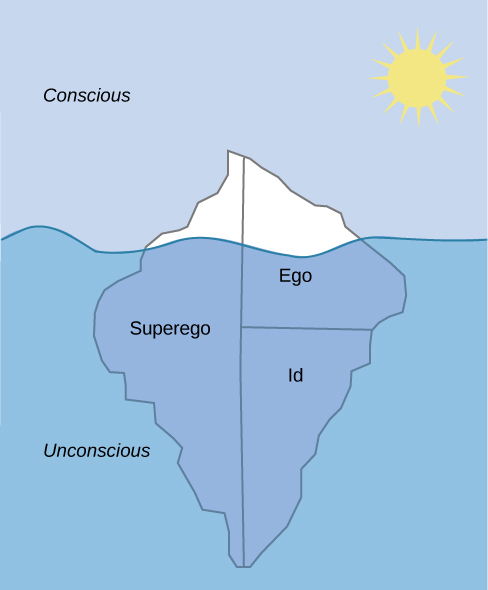
Freud's structural model: Freud said your personality has three parts. The id wants what it wants right now (food, sleep, sex, comfort). The superego is your conscience, telling you what's right and wrong. The ego is the mediator, trying to balance the id's desires with the superego's rules while dealing with reality.
Defense mechanisms: Your ego uses these unconscious tricks to protect you from anxiety. Repression pushes threatening thoughts into the unconscious. Projection attributes your own unacceptable feelings to others. Rationalization creates logical explanations for irrational behavior. Displacement directs feelings toward a safer target. Sublimation channels unacceptable impulses into socially acceptable activities like art or sports. Denial is refusing to accept reality. Reaction formation is acting the opposite of how you feel. Regression is reverting to childlike behavior under stress. The exam asks about these a lot.
Neo-Freudian perspectives: Later psychodynamic thinkers like Adler, Horney, and Jung kept some of Freud's ideas but moved away from his emphasis on sexuality. Adler focused on feelings of inferiority and striving for superiority. Horney challenged Freud's views on women. Jung introduced the concept of the collective unconscious and archetypes.
Image: OpenStax Psychology 2e (CC BY 4.0)
Carl Rogers and self-concept: Rogers focused on how people see themselves. Your self-concept includes all your beliefs about yourself. Rogers believed people need unconditional positive regard (acceptance without conditions) to develop a healthy self-concept. When people only get approval for certain behaviors, they develop conditions of worth and hide parts of themselves.
Congruence: Rogers said you're healthy when your real self matches your ideal self. Incongruence (mismatch) leads to anxiety and unhappiness.
⚠ Watch out for:
Freud's theories are old and often wrong, but the exam still tests the structural model and defense mechanisms because they're part of the history of psychology. Be careful with defense mechanisms. Repression is not the same as suppression. Repression is unconscious. Suppression is intentionally pushing something away. Also, don't confuse Rogers' humanistic approach (self-concept and unconditional positive regard) with the psychodynamic approach (unconscious drives and defense mechanisms).
🧪 Practice with StarSpark
🃏 Flashcards · 25 cards
Topic
AP Psych: Psychodynamic and Humanistic Personality Theories
AP Psych: Psychodynamic and Humanistic Personality Theories
Description
Id, ego, superego, unconscious processes, humanistic approach to personality development and growth
Try these in StarSpark → Flashcards or New Assignment
Topic 4.5: Social-Cognitive and Trait Theories of Personality
If Freud was about unconscious drives, these theories are about what you're like and how you interact with your environment.
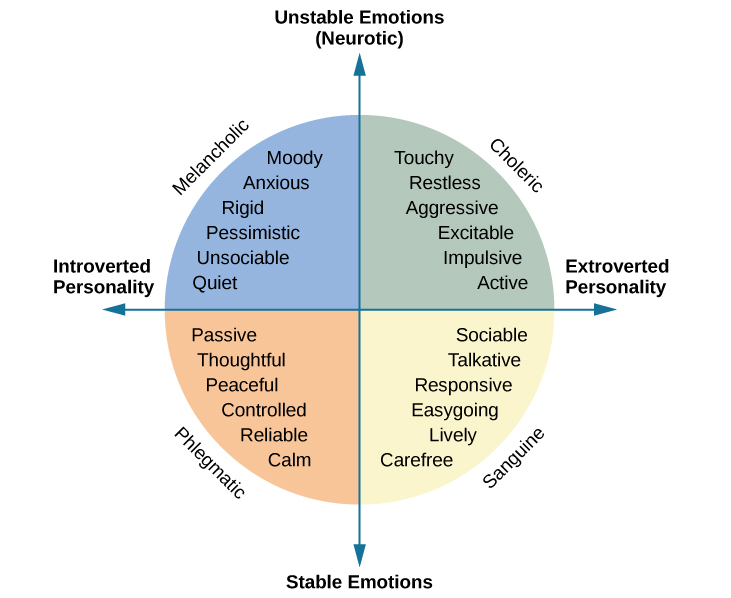
Image: OpenStax Psychology 2e (CC BY 4.0)
Key concepts to know:
Big Five personality traits: Also called OCEAN, these five dimensions describe most personality variation. Openness to experience (imaginative, curious), conscientiousness (organized, responsible), extraversion (outgoing, energetic), agreeableness (compassionate, cooperative), and neuroticism (anxious, sensitive). These are measured by factor analysis and are pretty reliable across cultures.
Image: OpenStax Psychology 2e (CC BY 4.0)
Factor analysis: This is the statistical method used to identify the Big Five. It finds groups of traits that go together. If many people who are friendly are also compassionate, those traits might belong to the same factor (agreeableness).
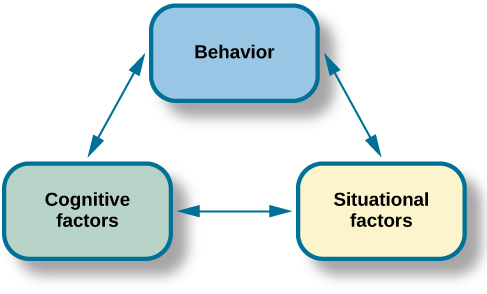
Albert Bandura's reciprocal determinism: Personality isn't just about your traits or just about your situation. It's the constant interaction between your thoughts (cognition), your environment, and your behavior. You shape your environment, and your environment shapes you. You choose friends who reinforce your personality, which reinforces those traits.
Image: OpenStax Psychology 2e (CC BY 4.0)
Self-efficacy: Your belief that you can succeed at a task. High self-efficacy makes you try harder and persist longer. If you think you can pass the AP exam, you study more and stick with it when it's hard. Bandura said self-efficacy comes from past successes, watching others succeed, encouragement from others, and how you feel physically.
Locus of control: Do you believe you control what happens to you (internal locus) or does luck and fate control it (external locus)? People with internal locus of control feel more responsible for their lives and usually achieve more. People with external locus often feel helpless.
Image: OpenStax Psychology 2e (CC BY 4.0)
Social-cognitive approach: This approach says personality emerges from the interaction of thoughts, situations, and behaviors. You're not just the same person everywhere. Your behavior changes based on context, your thinking about the context, and how your behavior affects the situation.
⚠ Watch out for:
Students sometimes think the Big Five explains everything about personality. It doesn't. It's just the most reliable trait model we have. Also, reciprocal determinism is not the same as free will. It's saying you and your environment constantly shape each other, not that you're completely free to be whoever you want.
🧪 Practice with StarSpark
🃏 Flashcards · 30 cards
Topic
AP Psych: Social-Cognitive and Trait Theories of Personality
Focus on
Big Five traits (OCEAN), reciprocal determinism, self-efficacy, locus of control, factor analysis
📝 Quiz · 20 questions
Topic
AP Psych: Social-Cognitive and Trait Theories of Personality
Description
Trait theory vs. psychodynamic approaches, Bandura's social-cognitive perspective, personality predictors
Try these in StarSpark → Flashcards or New Assignment
Topic 4.6: Motivation
Motivation is what drives you to do things. The exam covers multiple theories of what gets you moving.
Key concepts to know:
Drive reduction theory: You're motivated to reduce unpleasant drives. You're hungry (drive), so you eat (behavior). This reduces the drive and restores homeostasis (balance). The theory works well for basic needs like hunger and thirst, but it doesn't explain why you'd jump out of a plane or go to a concert.
Arousal theory: You're motivated to maintain an optimal level of arousal. Too little arousal is boring. Too much is stressful. This explains why you might do something thrilling even when you're not driven by hunger or thirst. Different people have different optimal arousal levels.
Incentive theory: You're motivated by rewards (incentives). Money, grades, social approval. You're pulled toward positive outcomes, not just pushed by drives. This is more flexible than drive reduction because the same incentive doesn't motivate everyone the same way.
Intrinsic motivation: You do something because you enjoy it or find it meaningful. You study because you're curious about psychology. Intrinsic motivation usually leads to deeper learning and persistence.
Extrinsic motivation: You do something for external rewards or to avoid punishment. You study because you need a good grade. Extrinsic motivation can undermine intrinsic motivation. If you're intrinsically motivated to draw, but then start getting paid for it, you might lose the joy.
⚠ Watch out for:
The exam might ask you to apply multiple motivation theories to the same scenario. A student might be driven by arousal theory (wanting challenge), incentive theory (wanting a scholarship), and intrinsic motivation (loving the subject). Don't pick just one. Also, remember that intrinsic motivation is usually better for long-term success and well-being than extrinsic motivation.
When people are motivated, how different theories explain behavior and achievement, biological vs. psychological drives
Try these in StarSpark → Flashcards or New Assignment
Topic 4.7: Emotion
You feel emotions constantly, but where do they come from? Different theories disagree.
Key concepts to know:
Body-first theory of emotion: One perspective says your body reacts first, and then you interpret that reaction as emotion. You run from a bear, notice your heart pounding, and conclude you're afraid. The emotion follows the physical response. This seems backwards, but there's evidence for it.
Simultaneous theory of emotion: Another perspective says your body and emotions happen at the same time. When you see a bear, your brain simultaneously triggers fear and physical responses (like increased heart rate). The emotion and body response don't cause each other. They happen together.
Two-factor theory of emotion: A third perspective says emotion requires two things: physical arousal and cognitive interpretation of that arousal. You feel your heart pounding, but whether you're afraid or excited depends on what you think is causing it. If you think the bear caused it, you're afraid. If you think a beautiful person caused it, you might feel attraction.
Facial feedback hypothesis: Your facial expressions can influence your emotions. If you force a smile, you might actually feel happier. Your face sends signals to your brain about what emotion you're expressing, and your brain interprets those signals. This works in reverse too. If you frown, you might feel sadder.
Universal emotions: Some emotions seem universal across cultures. Anger, disgust, fear, happiness, sadness, and surprise show up everywhere. People from different cultures recognize these emotions in facial expressions at high rates.
Culture and emotion: Even though some emotions are universal, how you express and experience them is culturally shaped. Some cultures emphasize emotional control more than others. Some emotions get more or less emphasis depending on cultural values.
⚠ Watch out for:
Students mess up the emotion theories by not keeping straight what causes what. Body-first: body reacts, then emotion. Simultaneous: body and emotion together. Two-factor: arousal plus interpretation equals emotion. The AP exam focuses on understanding these concepts rather than memorizing specific theory names. Also, the facial feedback hypothesis doesn't mean your emotions are all about your face. It's just saying your face is one input your brain uses to determine what emotion you're feeling.
🧪 Practice with StarSpark
🃏 Flashcards · 25 cards
Topic
AP Psych: Emotion Theories
Focus on
Body-first vs. simultaneous vs. two-factor emotion theories, facial feedback, universal emotions, cultural differences
📝 Quiz · 15 questions
Topic
AP Psych: Emotion Theories
Description
Distinguishing emotion theories, physiological arousal and emotional experience, culture and emotion expression
Try these in StarSpark → Flashcards or New Assignment
Summary: What Actually Matters for the Exam
Unit 4 is heavy with theories and real-world applications. The good news? Most of it makes intuitive sense once you see how it works. You recognize conformity and obedience in your own life. You've felt cognitive dissonance. You know people with different personalities. The key is mastering how to apply each theory to new scenarios and distinguishing between similar concepts that trip up test-takers.
Review Questions: Test Yourself
Your friend fails an exam and you think, "They didn't study hard enough." But when you fail, you blame the confusing questions. Which two attribution biases are at play here?
A person who believes recycling is important but never recycles feels uncomfortable about this. What is this discomfort called, and what are two ways they might reduce it?
In a group project, you notice everyone agrees with the leader's plan even though you all have private doubts. Is this conformity, groupthink, or obedience? Explain the difference.
A psychologist measures someone as high in neuroticism and low in agreeableness on a personality assessment. Which personality model is being used, and what behaviors might you expect from this person?
You're running alone in a park and see someone collapse. You rush to help. But in a crowded mall, you walk past someone lying on the ground. What phenomenon explains the difference in your behavior?
Want more practice? Paste these questions into StarSpark to generate a full quiz with explanations.
To lock this in further, try these prompts:
Study Tips for Unit 4
StarSpark Practice Prompts:
"Why did the Milgram participants obey even when they clearly didn't want to? What factors increased obedience?"
"Compare and contrast the Big Five trait theory with the psychodynamic approach. What are the strengths and weaknesses of each approach?"
"Explain how the two-factor theory of emotion accounts for situations where the same physical arousal feels like different emotions."
This review is aligned with the AP Psychology Course and Exam Description. AP is a registered trademark of the College Board, which was not involved in the production of this guide.