
A series for students who've heard calculus is hard (it's not)!
Quick answer: A limit in calculus describes the value a function is approaching, even if it never actually reaches that value. Limits are what enable us to calculate instantaneous rates of change, which in turn power derivatives, motion, and real-world growth. If you understand limits, calculus becomes far less intimidating.
You know that feeling. You're about to watch a video, and the loading bar hits 99%... then just sits there. 99.5%. 99.8%. 99.9%. It keeps getting closer to 100% but somehow never arrives.
Congratulations—you've just experienced a limit.
That loading bar is doing exactly what mathematicians spend a lot of time thinking about: approaching a value without necessarily reaching it. And weirdly enough, this idea unlocks some of the most powerful math ever invented.
Here's the simple version: a limit describes what value something is heading toward, even if it never gets there.
Think about walking toward a wall, but each step you take is half the distance remaining. The first step covers half the room. The next step covers half of what's left. Then half again.
You'd get incredibly close to that wall. Like, atoms-away close. But mathematically? You'd never touch it.
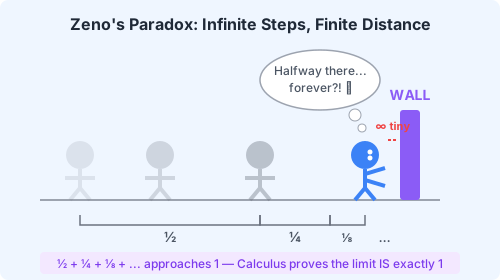
This isn't just a thought experiment. It's a 2,500-year-old puzzle called Zeno's Paradox, and ancient philosophers genuinely lost sleep over it. The Greeks didn't have the math to resolve it.
Calculus does.
Limits resolve paradoxes like this by allowing infinite processes to have finite, measurable outcomes.
Fair question. Here's why limits matter beyond philosophy class.
Imagine you're watching your favorite creator's follower count. They started the month at 100K and ended at 150K. Simple math: they gained 50K followers over 30 days, averaging about 1,667 new followers per day.
But that average hides the real story. What if they went viral on day 12 and gained 30K in a single afternoon? The average rate doesn't capture that spike.
What you really want to know is: how fast were they growing at that exact moment?
That's an instantaneous rate of change. And to find it, you need limits.
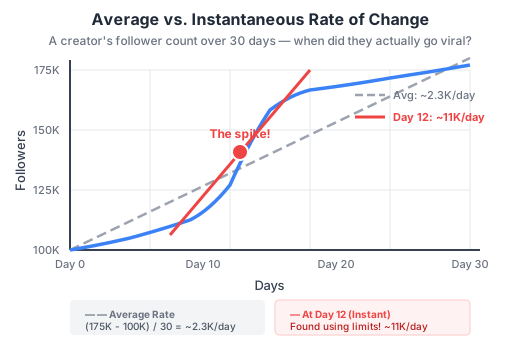
To sum it up, limits matter because they let us measure how fast something is changing at an exact moment, not just on average.
Let's slow down and connect this to actual math.
The example on the right shows how limits turn an average rate of change into an exact, instantaneous one.
Say a creator's follower count follows this formula:
where t is the number of days since they started posting, and f(t) is their follower count in thousands.
On day 2, they have:
On day 5, they have:
The average rate of change between day 2 and day 5 is:
This is the same slope formula you learned in algebra—rise over run. Nothing new yet.
But what if we want to know the exact growth rate on day 2—not averaged with other days?
We zoom in. Instead of looking from day 2 to day 5, let's look from day 2 to day 3:
Closer. Now day 2 to day 2.5:

Even closer. Day 2 to day 2.1:
.svg)
See the pattern? As we shrink the time gap, our answer is approaching 4. This process of shrinking the interval toward zero is exactly what a limit represents.
| Interval | Rate of Change |
|---|---|
| Day 2 → Day 5 | 7 |
| Day 2 → Day 3 | 5 |
| Day 2 → Day 2.5 | 4.5 |
| Day 2 → Day 2.1 | 4.1 |
| Day 2 → Day 2.01 | 4.01 |
| Day 2 → Day 2.001 | 4.001 |
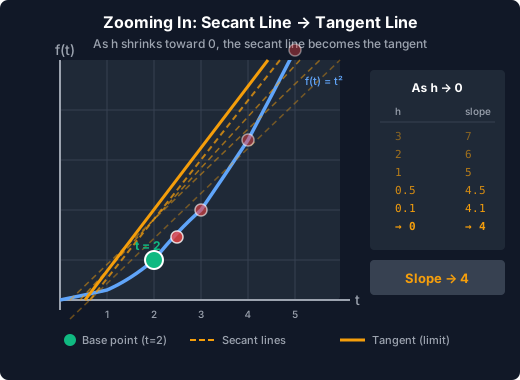
Here's where the magic happens.
We write this zooming-in process mathematically as:
.svg)
Translation: "What does the rate of change approach as the gap h gets infinitely close to zero?"
For our function .svg) . This limit equals exactly 4.
. This limit equals exactly 4.
Not approximately 4. Not "basically" 4. Exactly 4K followers per day at the precise instant of day 2.
That's what limits give us: the ability to capture an instantaneous rate of change even though "an instant" has no duration to measure.
Your textbook will show limits written as:
.svg)
This reads as: "The limit of f(x), as x approaches a, equals L."
Some examples:
.svg)
As x gets closer and closer to 3, the expression 2x + 1 gets closer and closer to 7. (In this case, it actually reaches 7—limits aren't always dramatic!)
.svg)
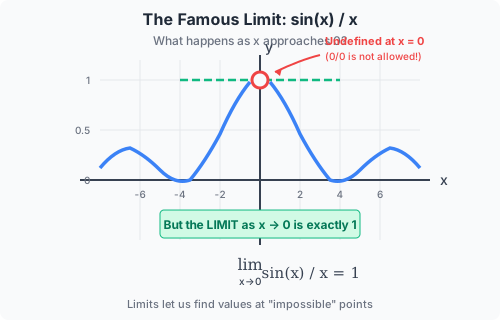
This one's famous. You can't plug in x = 0 directly (you'd get 0/0, which is undefined), but as x approaches 0, the fraction approaches 1. Limits let us handle these "impossible" situations.
This is the same math behind why your grade can tank after one bad test, but takes forever to climb back up. The rate of change isn't constant—and understanding when and how fast things change is surprisingly powerful.
It's also how Netflix decides what's "trending" (not just total views, but how fast views are growing right now), how game physics make your character accelerate smoothly, and how doctors measure how quickly a medication is entering your bloodstream.
So we've got this tool—limits—that lets us zoom in infinitely close to a single moment and find the exact rate of change there.
But doing that calculation every time (shrinking h, making tables, etc.) is tedious. What if there was a shortcut? A formula that instantly gives you the rate of change at any point?
There is. It's called a derivative.
That's Part 2 (coming soon).
Limits are one of those topics that can feel abstract at first, especially if you’re used to memorizing formulas instead of understanding what’s really happening. The key is guided practice that slows things down, explains why each step works, and helps you see how limits connect to derivatives and real problems. Tools like StarSpark.AI are designed to support this kind of learning by walking students through limits step by step, adapting explanations when something doesn’t click, and reinforcing concepts until they actually make sense, not just until the homework is done.
Students can explore this approach with a 14-day free trial and see whether it helps limit finally click.
Limit: The value a function approaches as the input gets closer to a specific number.
Average rate of change: The change between two points over an interval (slope of a secant line).
Instantaneous rate of change: The exact rate of change at a single moment, found using limits.
Derivative: A formula that gives the instantaneous rate of change at any point
Start learning with StarSpark today.
Free for 14 days, no credit card needed.