It may come as a surprise to some, but most kids’ struggles in math don’t come from a lack of effort. They come from a mismatch.
Within the U.S. education system, students are often pushed into material they aren’t ready for, taught in ways that don’t click for them, or held back by content they’ve already outgrown. Just because a student is in a certain grade doesn’t mean their math skills are actually aligned to that level.
At StarSpark, personalized learning starts with accurate measurement and intentional placement. Math works like building blocks. If earlier foundations are shaky, the entire structure becomes unstable. And if you don’t know where a student truly is, it’s impossible to help them move forward without gaps and frustration piling up along the way.
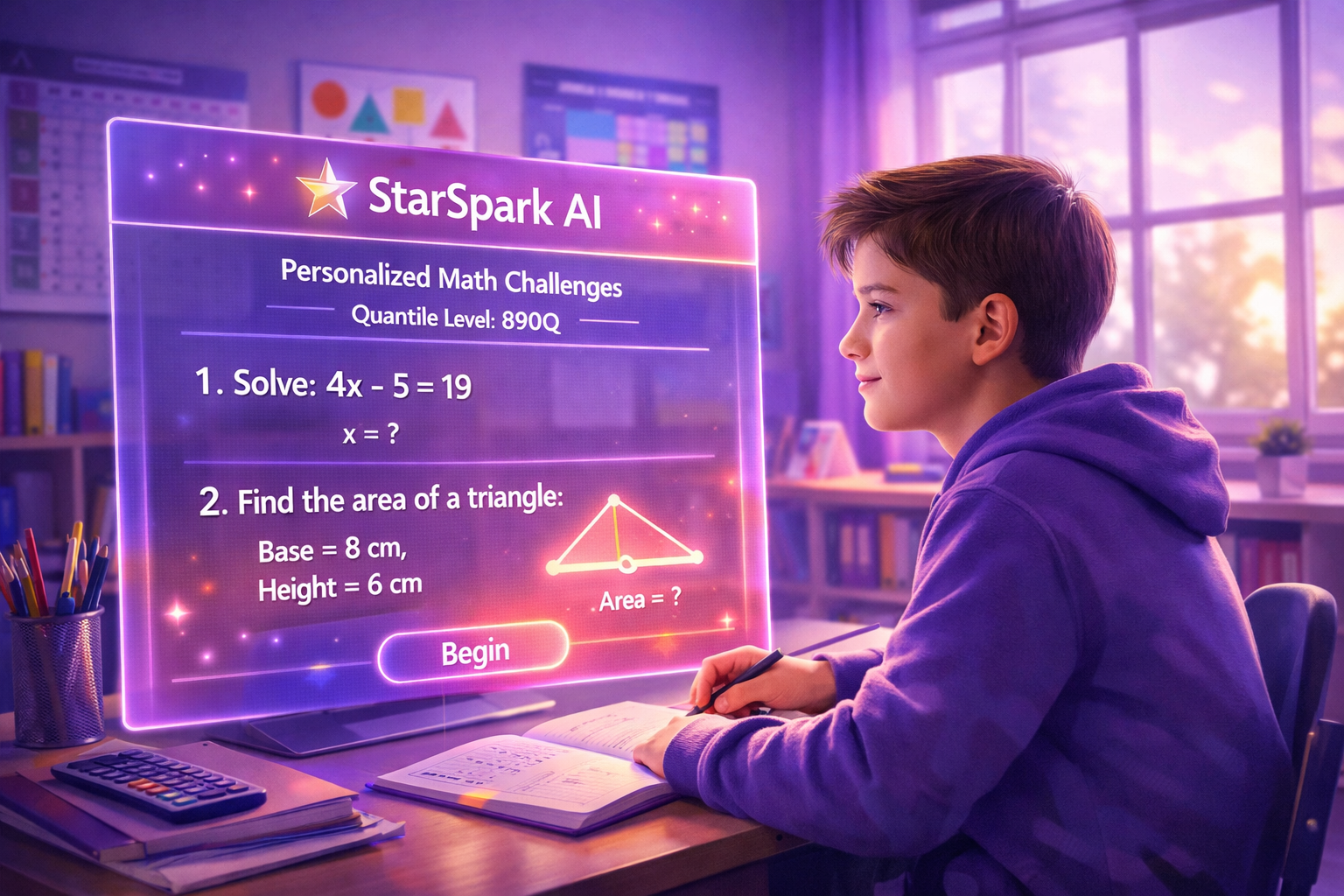
That belief is what led us to work with MetaMetrics, the organization behind the Quantile Framework for Mathematics, a research-backed system used nationwide to understand math readiness and progression.
This work enables StarSpark’s AI teachers to tailor instruction, practice, and guidance to a student’s actual level of understanding, rather than just their age or grade.
Learn more about StarSpark's partnership with MetaMetrics here: MetaMetrics and StarSpark AI Adapt Math Learning to Each Student’s Unique Strengths
The Quantile Framework places both students and math concepts on a shared scale. To put it simply, it helps answer two important questions:1. What has a student mastered?2. What is this student ready to learn next?When these two questions are answered accurately, a few things are impacted:
This isn’t about labeling students or locking them into a level that doesn’t reflect their age or school placement. It’s about choosing the right amount of challenge so learning stays productive and students are set up for long-term success, and build stronger math skills.
Measurement on its own isn’t helpful unless it’s applied thoughtfully.Inside StarSpark.AI, readiness data helps guide how students learn across the platform, while still leaving room for human judgment and parent choice.
Measurement, however, is not a mandate. We work alongside parents to determine the best starting point for their child. In some cases, a student may be in sixth grade but currently demonstrating fourth-grade math readiness. Our data may suggest rebuilding foundational skills first, while a parent may prefer their child remain in sixth-grade material.
We honor that choice. At the same time, we’re transparent about what it can mean. Working above a student’s current readiness level can introduce friction and frustration. When that happens, StarSpark provides added guidance and support while closely monitoring progress.
Our role isn’t to dictate learning paths. It’s to provide clear insight, explain tradeoffs, and support families in making informed decisions. That balance between data, professional judgment, and parent partnership is core to how StarSpark.AI works.
Many learning platforms today optimize for speed and surface-level results. Faster answers. Faster completion. Faster progress.
We didn’t.
We intentionally chose to design StarSpark around personalization, learning science, and mastery-based progression. We’ve seen what happens when students rush through math without a solid understanding. Confusion compounds. Confidence erodes. Eventually, students start to believe they “just aren’t good at math.”By grounding StarSpark in established measurement frameworks and learning science, we’ve chosen a different path, one that prioritizes durable understanding over instant gratification.
What often surprises families is that this approach doesn’t slow students down. In fact, when learning is aligned to readiness and taught with clarity, progress tends to become both more effective and more efficient. Many students see meaningful improvements in understanding and confidence quickly, and in some cases, measurable gains in performance within a few months.
Speed isn’t the goal. Understanding and deepening conceptual understanding is an outcome that move students forward faster.
From the start, we made a conscious decision to build StarSpark alongside families, meaning listening closely to what parents actually need, not what looks impressive on a product roadmap
.One thing we heard again and again was simple: most parents don’t want more dashboards. They want clarity, transparency, and reassurance that learning is actually working.
That clarity shows up in practical ways. Parents can see where their child is building confidence, where they’re getting stuck, and whether progress is moving forward or quietly stalling. Not just which problems were completed, but whether understanding is deepening over time.
Accurate measurement makes that possible. It allows StarSpark to surface meaningful progress instead of surface activity, and it gives parents a clearer sense of pace, whether their child is moving too quickly, struggling with foundational gaps, or ready for the next challenge.
For many families, that visibility is what restores trust in the learning process. Less hovering. Fewer nightly battles. More confidence that the time spent learning is actually helping their child move forward.
StarSpark was built to support students over time, not just help them get through tonight’s homework. From the beginning, we made a deliberate choice to prioritize deep understanding over vanity features or feel-good messaging. Learning isn’t always flashy, and real progress doesn’t always happen instantly, but it’s what actually changes a student’s relationship with math.
By grounding our platform in research-backed measurement, thoughtful instruction, and guided support, we focus on helping students build skills that last. Understanding deepens. Confidence grows. And math starts to feel manageable instead of intimidating.
This company was built with the intention of making a real impact on students, not just in the next assignment, but over the course of their learning journey. For us, personalized learning isn’t about optics or speed. It’s about doing right by students and families, and helping learning truly stick.
Start learning with StarSpark today.
Free for 14 days, no credit card needed.