A series for students who've heard calculus is hard (it's not)!
Quick answer: A derivative tells you how fast something is changing at one exact moment—not averaged over time, but right now. If limits let us zoom in infinitely close, derivatives give us a formula to capture that instant for any point. Derivatives power everything from speedometers to trending algorithms to game physics.
If you haven't checked out Calculus Demystified, Part 1: Getting Infinitely Close, click here before diving into Part 2!
Freeze Frame
Watch: an interactive StarSpark lecture on derivatives
Here is a lecture from the StarSpark platform that connects a function, its first derivative, and its second derivative into one story: increasing and decreasing behavior, extrema, concavity, and inflection points, tracked across an interactive three-graph simulation. It is an example of the guided, interactive lessons on the platform, pause anytime to work a concept check before the answer is revealed.
You know those moments in sports where everything matters in a split second? A three-pointer at the buzzer. A photo finish decided by hundredths of a second. The exact instant a goalkeeper's fingertips touch the ball.
Or think about anime—those epic fight scenes in Demon Slayer or Jujutsu Kaisen where time slows down and you see every detail of the attack.
What if math could do that? What if you could freeze time and measure exactly what's happening at one precise instant?
That's what a derivative does.
Quick Recap: How We Got Here
In Part 1, we discovered limits —the math of getting infinitely close.
As a refresher, a limit describes what value something is heading toward, even if it never gets there.
We used limits to answer a tricky question: if a creator's followers grow according to f(t) = t² + 100, how fast are they growing at exactly day 2? Not averaged over a week. Not roughly. Exactly at that instant.
We zoomed in closer and closer:
| Gap |
Rate Of Change |
| 3 days |
7 |
| 1 day |
5 |
| 0.1 days |
4.1 |
| 0.01 days |
4.01 |
| 0 |
4 |
The answer was 4K followers per day, found by taking the limit as our time gap shrank to zero. That process—finding the instantaneous rate of change using limits—has a name.
It's called a derivative.
What's a Derivative?
Here's the simple version: a derivative tells you how fast something is changing at any given moment.
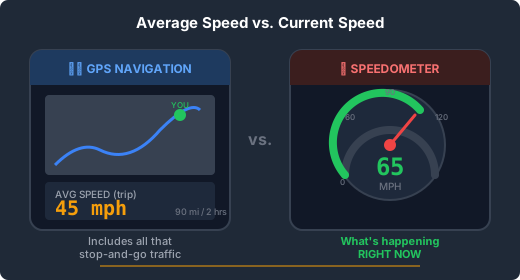
Think about a road trip. Your GPS shows two numbers:
- Average speed: 45 mph — you've covered 90 miles in 2 hours
- Current speed: 65 mph — what your speedometer reads right now
The average includes all that stop-and-go traffic from earlier. But
right now, you're cruising on the open highway.
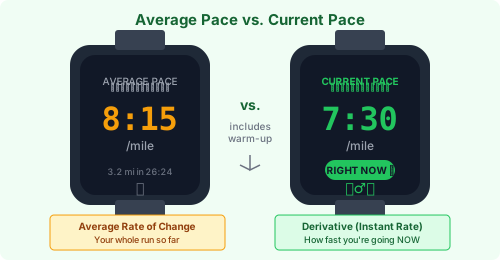
Same thing if you're a runner checking your watch mid-run:
- Average pace: 8:15/mi — your overall pace for the run so far
- Current pace: 7:30/mi — you're pushing hard on this stretch
Your average includes that slow first mile when you were warming up or maybe going uphill. But right now, you're flying.
That difference? That's exactly what we explored in Part 1:
| Concept |
GPS Example |
Running Example |
Math Term |
| Over the whole trip/run |
Average speed (45 mph) |
Average pace (8:15/mi) |
Average rate of change |
| Right this instant |
Current speed (65 mph) |
Current pace (7:30/mi) |
Derivative |
The derivative gives you the speedometer reading, not the trip summary.
Connecting to Part 1
Remember our follower count function from Part 1?
f(t) = t² + 100
Where t is days and f(t) is followers in thousands.
- f(t) tells you the total followers at time t
- f'(t) tells you how fast followers are growing at that moment
We discovered that at t = 2, the instantaneous growth rate was exactly 4K followers per day. But we had to build a table, shrink h toward zero, and spot the pattern. That's tedious. What if there was a shortcut—a formula that instantly tells you the rate of change at any point?
There is. That formula is the derivative.
The Notation
Your textbook will show derivatives written a few different ways. They all mean the same thing:
f'(x) — read as "f prime of x"
This is the most common notation. If your original function is f(x), its derivative is f'(x).
dy/dx — read as "dee y dee x"
Here, y is a function of x. So we could say y=f(x). This notation reminds you that a derivative is a ratio of tiny changes: how much does y change when x changes by a tiny amount?
The Power Rule: Your First Shortcut
Here's the good news: you don't have to build a limit table every time.
For our function f(t) = t² + 100, the derivative is:
f'(t) = 2t
How did we get that? There's a pattern called the power rule:
If f(x) = xⁿ, then f'(x) = n · xⁿ⁻¹

"Bring the power down, reduce the power by 1"
Let's check it:
| Function |
Derivative |
Pattern |
|
|
2t |
Bring down 2, reduce to t¹
|
|
|
3t² |
Bring down 3, reduce to t²
|
|
|
4t³ |
Bring down 4, reduce to t³
|
|
|
0 |
Constants don't change |
So for f(t) = t² + 100:
- Derivative of t² is 2t
- Derivative of 100 is 0
- Total: f'(t) = 2t + 0 = 2t
Now let's verify our Part 1 result:
f'(2) = 2(2) = 4
At t = 2, the derivative equals 4K followers/day. That matches exactly what we found by building the limit table! But now we got it instantly with a formula.
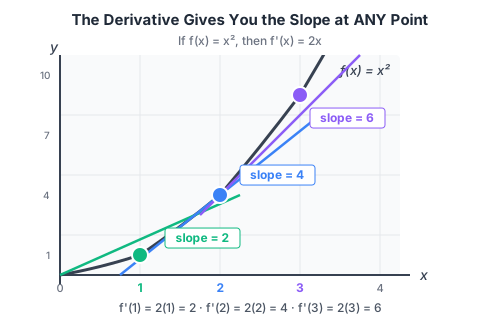
The derivative f'(t) = 2t gives us the slope at *any* point:
- At t = 1: slope = 2(1) = 2
- At t = 2: slope = 2(2) = 4 ← Confirmed!
- At t = 3: slope = 2(3) = 6
Pop Culture Example: Viral Video Momentum
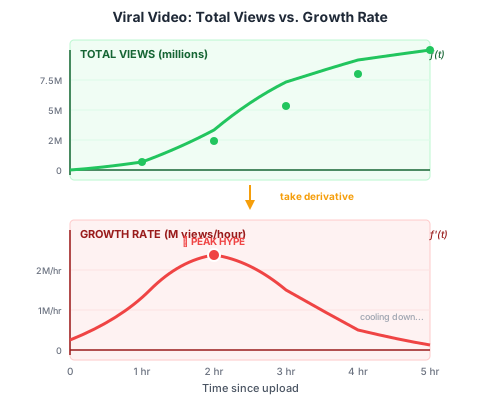
Imagine you're watching a MrBeast video climb in views:
| Time After Upload |
Total Views |
| 1 hour |
500,000 |
| 2 hours |
1,800,000 |
| 3 hours |
4,000,000 |
| 4 hours |
6,000,000 |
| 5 hours |
7,500,000 |
The total views keep going up. But look closer—the speed of growth is changing:
- - Hour 1→2: gained 1.3M views (🔥 heating up)
- - Hour 2→3: gained 2.2M views (🔥🔥 going viral)
- - Hour 3→4: gained 2M views (still hot, but slowing...)
- - Hour 4→5: gained 1.5M views (cooling down)
The derivative at any moment tells you the hype momentum—how fast views are climbing right then. YouTube's algorithm cares about this. A video gaining 100K views/hour right now is more "trending" than one that gained 1M yesterday but only 10K today. The derivative captures what's happening now.
Real-World Applications
Derivatives are everywhere once you know where to look.
Video Game Physics
When your character jumps in a game, they don't teleport up and down. They accelerate smoothly, slow at the peak, then speed up falling.
- Position = where your character is
- Velocity = derivative of position (how fast they're moving)
- Acceleration = derivative of velocity (how fast their speed is changing)
Game engines calculate derivatives constantly to make movement feel realistic.
Robotics & Drones
Ever wonder how a drone hovers so smoothly, or how your robot arm stops exactly where it should? They use something called a PID controller. The "D" stands for Derivative — it measures how fast the error is changing and corrects before things go wrong. Without derivatives, your robot would overshoot and wobble constantly.
TikTok's FYP Algorithm
Your For You Page ranks videos partly on engagement
velocity—not just total likes, but how fast likes are coming in
right now. That's a derivative.
Spotify's "Trending" Detection
A song with 10M total streams that gained 50K today is "cold." A new song with 500K streams that gained 200K today is "hot." The derivative (streams per day) identifies what's trending.
Your Running Watch
When your watch shows "current pace," it's calculating a derivative—how fast your position is changing right now, not your average over the whole run.
Your Phone Battery
Your battery drains at 1%/hour while idle but 15%/hour while gaming. Same battery, different derivatives — the rate of change depends on what's happening
right now.
The Big Idea
A derivative answers the question: "How fast is this changing right now?"
| Original Function |
Derivative |
Example |
| Position |
Speed |
Mile marker → speedometer |
| Total Followers |
Growth Rate |
104K followers → 4K/day |
| Total views |
Views per hour |
4M views → 2.2M/hr at peak |
| Distance run |
Current pace |
3 miles → 7:30/mi right now |
Every time you see a rate—miles per hour, dollars per day, likes per minute—you're looking at a derivative.
What's Next
So derivatives tell us how fast things change at any instant. But here's a question:
What if you only know the rate, and want to find the total?
Your running watch showed your pace throughout the run: 8:00/mi, then 7:30/mi, then 7:45/mi... but how far did you actually go? Your speedometer showed 30 mph, then 45 mph, then 65 mph... but what's the total distance traveled? You need to add up all those tiny pieces. Infinitely many of them.
That's an integral—and it's the perfect mirror of what we just learned. That's Part 3.
Learning Derivatives Without the Frustration
Derivatives can feel mechanical if you just memorize rules without understanding where they come from. The key is connecting the formula (f'(x) = 2x) back to the limit process we built in Part 1—seeing that the shortcut and the long way give you the same answer.
Tools like StarSpark.AI support this kind of learning by walking students through derivatives step by step, connecting the "why" to the "how," and adapting explanations when something doesn't click. Students can explore this approach with a 14-day free trial and see whether derivatives finally make sense.
Key Definitions
- Limit: The value that a function approaches the output for the given input values approach.
- Derivative: A formula that gives the instantaneous rate of change at any point
- f'(x) or dy/dx: Notation for "the derivative of f"
- Power Rule: If f(x) = xⁿ, then f'(x) = n · xⁿ⁻¹
- Instantaneous rate of change: How fast something is changing at one exact moment (derivative)
- Average rate of change: Change over an interval (slope of secant line)
- Tangent line: A line that touches a curve at exactly one point; its slope equals the derivative there
Frequently Asked Questions About Derivatives