



The best way to study for a math final is to start at least two weeks early, focus on active problem-solving instead of re-reading notes, and use spaced practice to improve retention.
Math finals season hits differently. You've got weeks of material to review, formulas you half-remember, and a ticking clock. The good news? Preparing for a high school math final does not have to be a last-minute disaster. The students who do well are not necessarily the "math people." They are the ones who studied smarter, started earlier, and knew what actually to practice.
Here is exactly how to do it, backed by real research.
How Far Out Should You Start Studying for a Math Final?

The honest answer: at least two weeks before the exam.
Math is not a subject you can absorb in one night. Unlike history, where you might skim and recall, math requires practice. Your brain needs time to build problem-solving muscle memory.
A 2016 study from Dartmouth's Sean Kang, published in Policy Insights from the Behavioral and Brain Sciences, analyzed hundreds of studies and confirmed what most students learn the hard way: spacing out your study sessions over time produces better long-term retention than cramming
If you have less than two weeks, do not panic. You just need to be more strategic about where you spend your time.
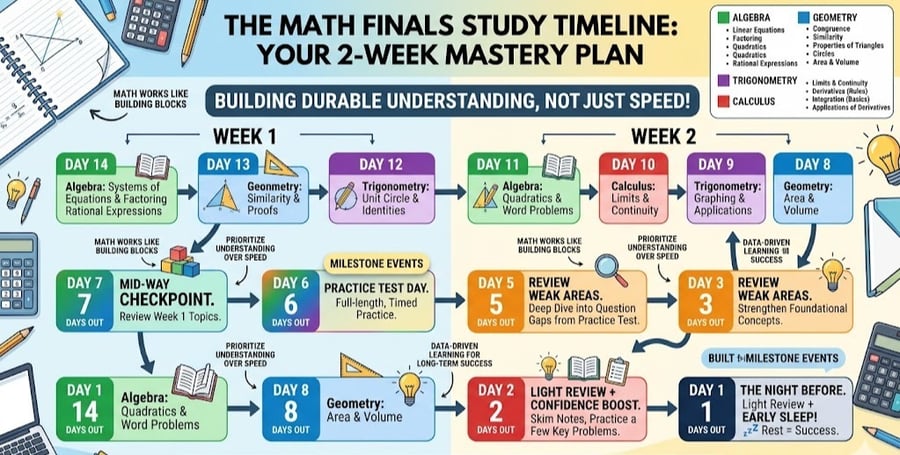
Step 1: Map Out Exactly What Is on the Final
Before you open a single textbook, get specific. Pull out your syllabus or ask your teacher directly which topics the final covers. A lot of students just start reviewing everything from day one and burn out fast. Do not do that.
Common high school math final topics include:
- Algebra: Solving and graphing equations and inequalities, systems of equations, quadratic functions, factoring, polynomials
- Geometry: Proofs, triangle theorems, circle theorems, area and volume formulas
- Pre-Calculus / Trigonometry: Unit circle, trig identities, logarithms, sequences and series
- Calculus: Limits, derivatives, integrals (and for AP Calc, the full breadth of the AP curriculum)
Once you know what to focus on, the next step is practicing the right way. This is where tools like StarSpark.AI can help by giving you targeted practice based on your exact class instead of generic problem sets.
Step 2: Stop Re-Reading Your Notes. Do Problems Instead.
This is the single biggest mistake students make. They re-read their notes, highlight formulas, and feel productive. But reading math is not the same as doing math.
A landmark study by Karpicke and Roediger (2008), published in Science, found that students who tested themselves on material retained 80% of it, compared to just 30% for students who only reviewed their notes. Re-reading after learning produced almost no additional benefit. Repeated self-testing produced massive gains.
More recent data backs this up: students using active recall (working problems without looking at notes first) retain around 57% of material after a week, versus only 29% for passive re-reading, and those numbers diverge even further after two weeks.
Here is a simple framework that actually works:
- Review the concept (5-10 minutes max)
- Close your notes and try practice problems cold
- Check your work and understand where you went wrong
- Redo those wrong problems the next day
That last step matters more than most students realize. Revisiting material after a short break is what researchers call spaced retrieval practice, and consistently outperforms doing everything in one sitting.
A STEM-focused meta-analysis found that students who used spaced practice in precalculus also performed better in their subsequent calculus courses. The benefit compounds over time.
Where to find practice problems:
- Old tests and quizzes from the semester
- Your textbook's chapter review sections
- Khan Academy (free, organized by topic, with step-by-step hints)
- College Board's AP Classroom if you are in AP math
- StarSpark AI for personalized practice that adapts to your exact class, walks you through problems step by step, and helps you fix mistakes in real time instead of just showing answers
Step 3: Build a Formula Cheat Sheet (Even If You Cannot Use One on the Exam)
Making a one-page summary of all formulas and key concepts is one of the best study moves you can make before your final exams. The process of deciding what is important enough to write down forces you to process the material you've learned over the semester.
Your cheat sheet should include:
- All formulas you are expected to know (quadratic formula, Pythagorean theorem, trig ratios, derivative rules, etc.)
- Key rules and theorems your teacher emphasized
- Common "gotcha" mistakes you keep making, written as reminders to yourself (for example: "flip the inequality sign when dividing by a negative")
Even if you have the whole thing memorized by exam day, that is the point. You built the memory by making the sheet.
Step 4: The Week Before the Final
This is your execution week. About 30 to 45 minutes of focused daily practice is more effective than marathon sessions. After roughly 4 hours of serious mental work, research shows returns diminish sharply, and stress increases. Keep sessions on the shorter side and focused.
Here is a practical study schedule:
7 days out: Review your priority list. Start with your shakiest topics first.
5 to 6 days out: Take a full practice test under timed conditions if you can find one. Treat it like the real exam.
3 to 4 days out: Go back over every problem you got wrong on that practice test. Do not just read the solution. Redo the problem yourself.
2 days out: Light review only. Go over your cheat sheet, scan your notes on anything still unclear, but do not try to learn anything new at this point.
Night before: Do not cram! Review your formula sheet once, then stop. Get to bed. Getting a good night's sleep also impacts your ability to recall materials and perform well on the exam.
Step 5: Sleep Is Not Optional. It Is Actually Part of Studying.
If you take one thing from this post, let it be this: sleep is when your brain consolidates what you studied. Cramming instead of sleeping is not a trade-off that works in your favor.
A meta-analytic review published in Neuroscience & Biobehavioral Reviews analyzed five decades of sleep and memory research and found that sleep deprivation before learning caused a significant impairment in memory formation (effect size g = 0.621). Even restricting sleep to 6.5 hours (instead of the recommended 8-9 hours for teenagers) measurably hurts how well you retain what you studied.
The all-nighter is a myth.
Step 6: What to Do on Exam Day
A few small habits that make a real difference:
Eat something real. Your brain runs on glucose. A light meal before an exam improves both focus and recall. Skip the giant, greasy breakfast, which may make you a bit sleepy.
Scan the whole test before starting. Spend two minutes reading through every problem first. This primes your brain to start working on harder problems in the background while you answer easier ones.
Do what you know first. Skip hard problems and come back. Getting early wins on easier questions builds momentum and stops panic from setting in.
Show every step of your work. Even if your final answer is wrong, partial credit is real. Most math teachers give points for correct process.
Check your work. Use leftover time to verify answers, especially multi-step problems where a small arithmetic error early can throw off the entire answer.
Math Anxiety Is Real. Here Is What the Research Says.
If math finals make you genuinely anxious, you are not alone. Research from the University of Chicago's Sian Beilock, one of the leading researchers on math anxiety, shows that roughly 17% of students experience high math anxiety, and up to 33% of students in OECD countries report getting tense completing math homework.
Math anxiety is not a personality trait. It is a learned response, and it can be unlearned. A few things that actually help:
- Doing brief written journaling about your worries before an exam (Beilock's own research shows this frees up working memory)
- Starting with problems you know you can solve to build early confidence
- Practicing under timed conditions before the real exam so the pressure feels less foreign
- Using a tool like StarSpark.AI, which gives you immediate, judgment-free feedback and adapts to your level in real time, so you can close gaps before they turn into stress during the exam
The more time you give yourself to prepare and catch up on areas you are shaky on, the more you math anxiety will subside.
The Common Mistakes That Cost Students Points
Rushing through setup. Students who slow down to read the problem carefully consistently outperform students who jump straight to solving. Re-read every question before starting.
Doing steps in their head. When you are nervous, mental shortcuts lead to errors. Write everything out.
Not double-checking units. In geometry and applied math problems, unit errors are a constant source of lost points.
Skipping problems and forgetting to return. Mark any problem you skip, or you will run out of time without finishing it.
Trusting the calculator without estimating first. Get a rough mental estimate before you calculate. If your answer is wildly different from your estimate, something went wrong.
Try to avoid these costly mistakes during your exam.
Frequently Asked Questions
How long should I study for a math final each day? 30 to 60 minutes of focused, active practice per day is more effective than a 4-hour session once a week. Studies on study habits show that students who study in shorter, consistent sessions retain significantly more than those who cram. Consistency beats volume.
What if I do not understand a concept at all? Go back to the basics before trying practice problems. Khan Academy is one of the best free resources for this because it breaks topics down from the ground up. Also, use your teacher's office hours. Most teachers are genuinely glad when students come in before the exam, not after.
What is the best way to study for a math test the night before? Keep it light. Review your formula cheat sheet, skim your notes on anything you still feel shaky on, then stop. Sleep. Cramming the night before math creates more anxiety and confusion than clarity.
How do I stop blanking during a math test? Start with an easier problem to build momentum. Math anxiety creates a working memory bottleneck, and early wins help break it. If you blank regularly during tests, practice under timed conditions before the real thing so the pressure feels familiar.
Can an AI tutor actually help with math finals prep? Yes, when it is used the right way. StarSpark.AI is built specifically for high school math and aligned to real course standards, so you are practicing exactly what shows up on your exams. It walks you through problems step by step, identifies your weak spots, and adapts practice in real time so you actually understand the material instead of memorizing steps.
You Have Got This
Math finals feel overwhelming because the material builds on itself. But the students who do well are not smarter. They are more prepared. They started early, practiced actively, and did not try to do everything in one night.
If you want a smarter way to prepare, this is where StarSpark.AI stands out. Instead of generic practice or answer shortcuts, it gives you a personalized AI math tutor that adapts to your exact course, walks you through problems step by step, and helps you fix mistakes in real time. It is built on real curriculum standards, so you are practicing what actually shows up on your exams.
When you combine the strategies in this guide with the right tools, you are not just preparing for one test. You are building real understanding that carries forward.
Two weeks. Focused practice. Real sleep. That is the difference between walking into your final stressed… and walking in ready.