
Unit 2 builds directly on Unit 1. Now that you understand atoms and electron configurations, it's time to learn how atoms bond together. You'll explore ionic bonds, covalent bonds, and metallic bonds. You'll draw Lewis structures, use VSEPR theory to predict molecular shapes, and connect all of this to the properties of compounds. This unit is where chemistry starts feeling less abstract and more like solving puzzles about how molecules are built.
Unit 2 makes up about 7-9% of the AP Chemistry exam. Focus your energy on these priorities:
What's in this review:
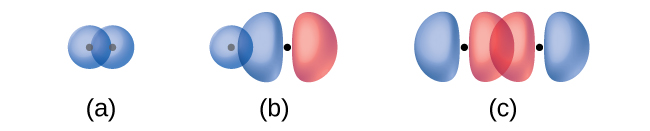
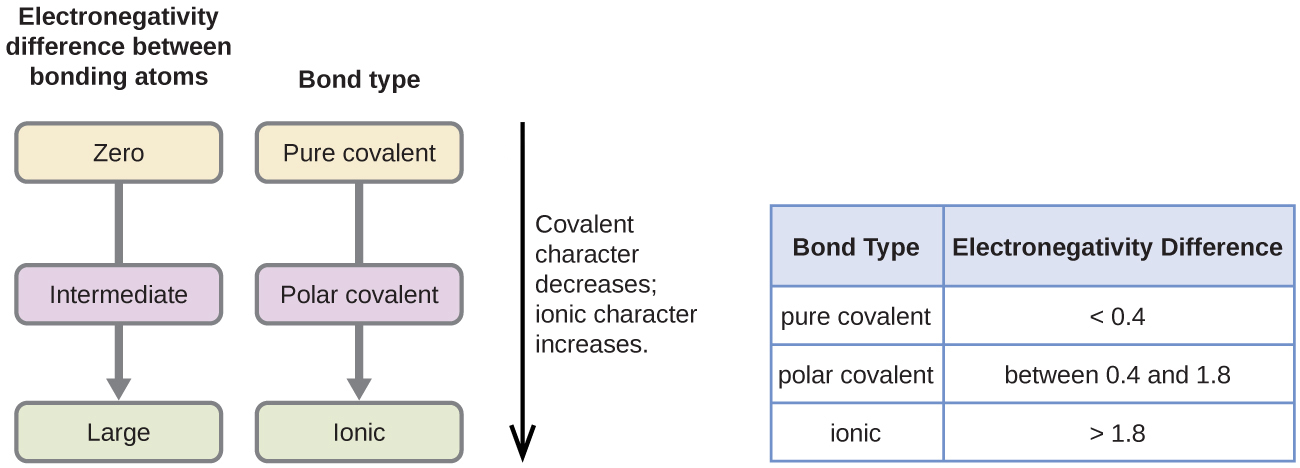
There are three main types of chemical bonds: ionic, covalent, and metallic. The type of bond that forms depends on the electronegativity difference between atoms and the nature of the elements involved.
Ionic bonds form between metals and nonmetals with large electronegativity differences. One atom transfers electrons to another, creating ions held together by electrostatic attraction. Covalent bonds form between nonmetals with similar electronegativity. Atoms share valence electrons to achieve stable configurations. Nonpolar covalent bonds form when two atoms have nearly equal electronegativity (both pull equally); polar covalent bonds form when atoms have different electronegativity (one pulls harder). Metallic bonds form between metal atoms, where valence electrons are delocalized in a "sea" around positive metal cores.
The key insight: bonding exists on a spectrum. There's no sharp line between ionic and covalent. All polar bonds have some ionic character, and the difference between ionic and covalent bonding is gradual, not distinct.
Key concepts to know:
⚠ Watch out for:
Don't rely only on electronegativity difference numbers. The exam expects you to consider actual properties: Does the compound conduct electricity when molten? Does it dissolve in water? Is it brittle or malleable? These properties tell you the bonding type. Also, remember that bonding is a spectrum, and most bonds between different atoms have at least some degree of polarity.
Intramolecular forces are the forces within a molecule (covalent bonds). The strength of these bonds determines the stability of the molecule. A potential energy diagram shows how potential energy changes as atoms move closer or farther apart. The lowest point on the curve is the equilibrium bond length (the distance at which the molecule is most stable). The energy required to separate atoms at this distance is the bond energy.
Bond order (single, double, triple) affects both bond length and bond energy. Higher bond order means shorter, stronger bonds. A triple bond is shorter and stronger than a double bond, which is shorter and stronger than a single bond between the same atoms.
Coulomb's law applies to ionic interactions: the strength of attraction between a cation and anion is proportional to the magnitude of their charges and inversely proportional to the distance between them. Smaller ions with higher charges interact more strongly.
Key concepts to know:
⚠ Watch out for:
Bond energy values are always positive because you're breaking bonds (endothermic). When you form bonds, energy is released. Don't confuse breaking bonds with forming bonds. Also, remember that Coulomb's law applies to all charged particles, not just ions in solid structures.
In an ionic solid, cations and anions are arranged in a 3D crystal lattice that maximizes attractive forces (between opposite charges) and minimizes repulsive forces (between like charges). The specific crystal structure depends on the size and charge of the ions, but the goal is always the same: stable, neutral arrangement.
You don't need to memorize specific crystal structures like NaCl or CsCl lattices. The exam focuses on understanding the concept: ions arrange themselves in repeating patterns that balance attraction and repulsion, and these structures explain the properties of ionic compounds (brittle, high melting point, conduct electricity when molten).
Key concepts to know:
⚠ Watch out for:
Don't memorize NaCl vs. CsCl structures. The exam won't test specific lattice types. Instead, focus on understanding why ionic compounds have high melting points (strong electrostatic forces), are brittle (layers slide and expose like charges that repel), and conduct electricity when molten (ions can move).
In a metallic solid, metal atoms lose valence electrons to form a delocalized "sea" of electrons. Positive metal cations are surrounded by this electron sea. The delocalized electrons allow metals to conduct electricity and heat, and they give metals their characteristic properties: malleability (ability to be hammered into shape) and ductility (ability to be drawn into wire).
Alloys are mixtures of metals (or metals with nonmetals). In an interstitial alloy, smaller atoms fill the gaps (interstices) between larger metal atoms. This makes the lattice more rigid and less malleable, like steel (iron with carbon atoms in the interstices). In a substitutional alloy, atoms of similar size replace each other in the lattice. Brass (copper and zinc) is a substitutional alloy.
Key concepts to know:
⚠ Watch out for:
Remember that alloys are NOT pure compounds with fixed ratios. They're mixtures, so the ratio of metals can vary. Also, don't confuse interstitial (smaller atoms in gaps) with substitutional (atoms replacing each other). Think of size: if the new atom is much smaller, it goes interstitial; if similar size, it substitutes.
A Lewis diagram (or Lewis structure) shows the valence electrons in a molecule or polyatomic ion as dots or lines. Dots represent lone pairs (pairs of electrons not shared), and lines represent bonding pairs (shared pairs). Lewis structures follow simple rules: count valence electrons, connect atoms with single bonds, then distribute remaining electrons as lone pairs.
The octet rule is a guideline (not an absolute rule) that atoms tend to form bonds until they have eight valence electrons (or two, for hydrogen). Most stable molecules satisfy the octet rule, but there are exceptions: boron compounds often have only six valence electrons; phosphorus, sulfur, and beyond can expand their octets.
Key concepts to know:
⚠ Watch out for:
Forgetting to count valence electrons correctly for ions is a common mistake. Always remember: a negative ion has MORE electrons than the neutral atom (add electrons for negative charge), and a positive ion has FEWER electrons (subtract for positive charge). Also, don't try to put lone pairs on the central atom first; outer atoms come first.
Resonance occurs when more than one valid Lewis structure can be drawn for a molecule, and the actual structure is a hybrid of all possibilities. For example, ozone (O3) and the nitrate ion (NO3-) have multiple resonance structures. The actual structure is an average, with bonds having fractional bond order between single and double.
Formal charge helps you decide which resonance structure is most likely. The formal charge on an atom is: (valence electrons) - (lone pairs) - (1/2 of bonding electrons). In the best Lewis structure, the sum of formal charges equals the ion's charge, and negative formal charges are on more electronegative atoms.
Key concepts to know:
⚠ Watch out for:
Formal charge is NOT the same as oxidation state. Formal charge is a bookkeeping tool for Lewis structures. Also, resonance is not the same as tautomerism or rotation. Resonance structures are different arrangements of the SAME electrons, not different molecules or rotations.
VSEPR theory (Valence Shell Electron Pair Repulsion) predicts molecular geometry based on Lewis structures. Electron pairs (bonding and lone) around the central atom repel each other and position themselves as far apart as possible. The number of electron pairs determines the electron geometry. Ignoring lone pairs gives the molecular geometry.
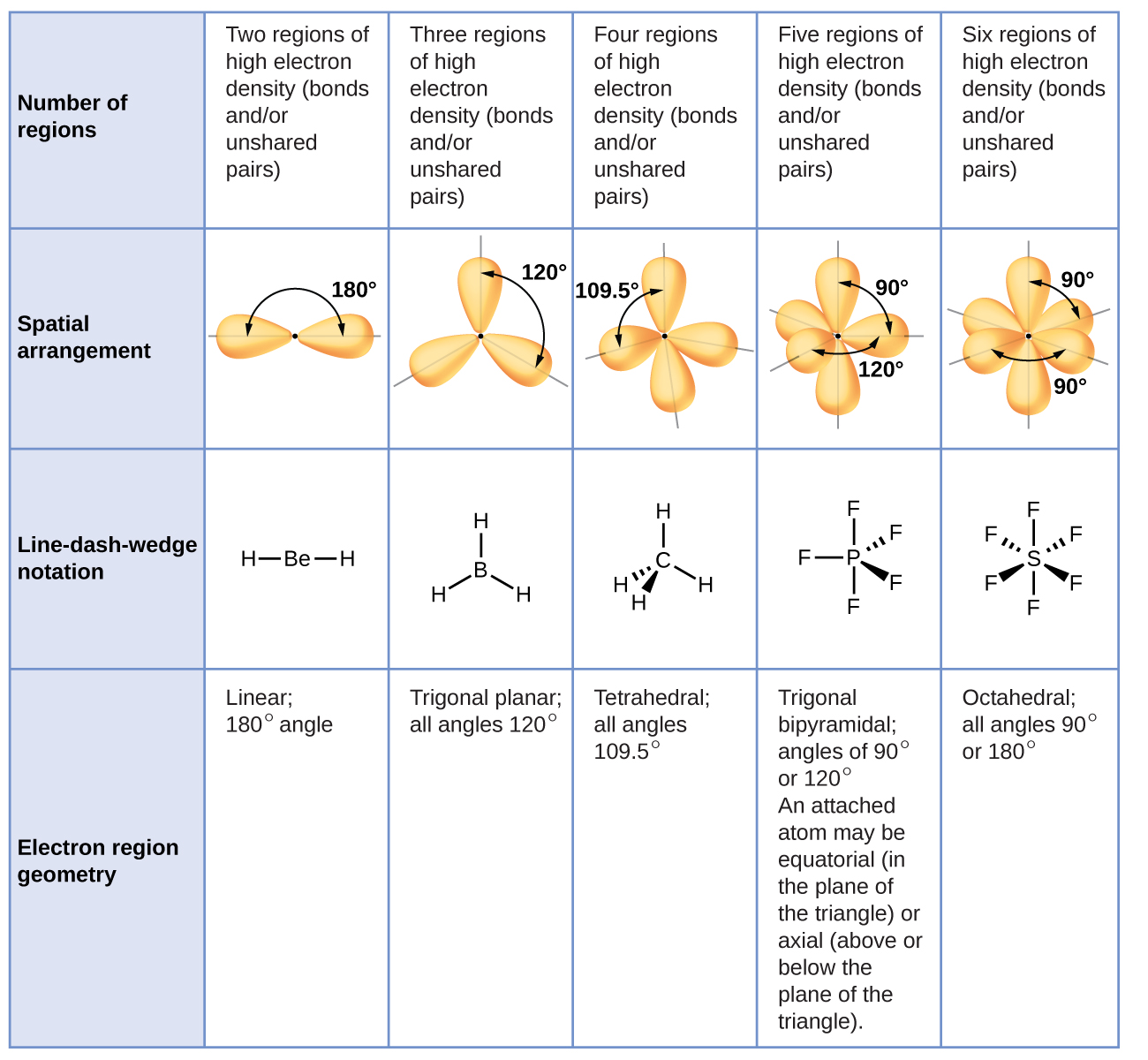
Hybridization describes the mixing of atomic orbitals to form new hybrid orbitals suitable for bonding. The type of hybridization depends on the number of electron pairs around the central atom:
Higher electron pairs involve d orbitals (sp3d, sp3d2), but the exam focuses on sp, sp2, and sp3.
Key concepts to know:
⚠ Watch out for:
Students often confuse electron geometry with molecular geometry. Always count ALL electron pairs (bonding AND lone) for geometry. Then, ignore lone pairs to name the molecular shape. Also, don't forget that hybridization of d orbitals is NOT tested at the AP level. Stick to sp, sp2, and sp3.
Draw Lewis structures constantly. This is your foundation for the rest of the unit. Once you can draw Lewis structures quickly and correctly, VSEPR and hybridization become much easier. Practice with simple molecules (H2O, NH3, CH4), then move to polyatomic ions and molecules with resonance.
Remember the VSEPR sequence. Lewis diagram > Count electron pairs > Determine electron geometry > Remove lone pairs > Identify molecular geometry > Predict bond angles. Follow this sequence every time, and you'll avoid mistakes.
Link geometry to hybridization. If you determine that the molecular geometry is tetrahedral, you already know the hybridization is sp3. The geometry and hybridization go hand in hand. Learn the patterns: linear = sp, trigonal planar = sp2, tetrahedral = sp3.
Test yourself on bond angles. Ideal tetrahedral = 109.5°. Ideal trigonal planar = 120°. Ideal linear = 180°. Lone pairs compress angles slightly below these ideal values. If a problem gives you unusual angles, think about how many lone pairs might be present.
You've covered all the topics in Unit 2. Before you move on, test yourself with these scenario-based questions. If you can answer them confidently, you're ready for Unit 3.
Review Questions: Test Yourself
Want more practice? Paste these questions into StarSpark to generate a full quiz with explanations.
Unit 2 takes your understanding of atoms (Unit 1) and shows you how they combine. Unit 3 moves to the next step: how the structure and bonding you learned in Units 1 and 2 determine the macroscopic properties of substances (boiling point, solubility, conductivity, etc.).
Check out the full AP Chemistry study plan to see how this unit connects to the rest of the course.
Other Unit Reviews:
For official AP Chemistry resources, visit apcentral.collegeboard.org.
This review is aligned with the AP Chemistry Course and Exam Description. AP is a registered trademark of the College Board, which was not involved in the production of this guide.
Start learning with StarSpark today.
Free for 14 days, no credit card needed.