Not all reactions happen at the same speed. Some are explosively fast, and others take years. Kinetics is the study of reaction rates and the mechanisms that control them. Understanding why some reactions are slow and how to speed them up is crucial for chemistry, biology, and industry.
๐ฏ What You Need to Know for the Exam
Unit 5 makes up about 7-9% of the AP Chemistry exam. Focus your energy on these priorities:
- Understanding how reaction rate depends on reactant concentration, temperature, surface area, and catalysts
- Writing and interpreting rate laws from experimental data, including reaction order and rate constants
- Using graphical methods to determine reaction order from concentration versus time data
- Explaining reaction mechanisms as sequences of elementary steps and connecting them to overall rate laws
- Understanding how activation energy, temperature, and particle collisions affect reaction rates
- Recognizing how catalysts work by providing alternative reaction pathways with lower activation energy
What's in this review:
- Reaction Rates
- Introduction to Rate Law
- Concentration Changes Over Time
- Elementary Reactions
- Collision Model
- Reaction Energy Profile
- Introduction to Reaction Mechanisms
- Reaction Mechanism and Rate Law
- Pre-Equilibrium Approximation
- Multistep Reaction Energy Profile
- Catalysis
- Study Tips for Unit 5
- Summary, Review Questions & Practice
Topic 5.1: Reaction Rates
A reaction rate measures how fast reactants are converted to products. Formally, reaction rate is defined as the amount of reactant consumed or product formed per unit of time. Temperature, reactant concentration, surface area, and catalysts all influence how fast a reaction goes.
The rate of change of reactant and product concentrations are determined by stoichiometry. If a reaction has coefficients 2A โ B, then for every 2 moles of A consumed, 1 mole of B forms. This stoichiometric relationship means that the rate of A consumption is twice the rate of B formation.
Key concepts to know:
- Reaction rate: The rate at which reactants are consumed or products are formed, measured as change in concentration per unit time.
- Factors affecting rate: Reactant concentration, temperature, surface area, catalysts, and environmental factors all influence reaction speed.
- Stoichiometric relationships: The rates of change of different reactants and products are connected by stoichiometric coefficients.
โ Watch out for:
Don't confuse reaction rate with reaction order. Rate tells you how fast a reaction goes at any given moment. Order tells you how rate depends on concentration. These are different concepts.
๐ง Practice with StarSpark
๐ Flashcards ยท 15 cards
Topic
AP Chemistry: Reaction Rates and Experimental Parameters
Focus on
Factors affecting rate, stoichiometric relationships between reactant and product rates
๐ Quiz ยท 10 questions
Topic
AP Chemistry: Reaction Rates and Experimental Parameters
Description
Calculating rates, understanding how conditions affect reaction speed, stoichiometric rate relationships
Try these in StarSpark โ Flashcards or New Assignment
Topic 5.2: Introduction to Rate Law
A rate law is an equation that expresses reaction rate as a function of reactant concentrations. It tells you mathematically how rate depends on the amounts of reactants present. Rate laws cannot be determined from equations alone; they must be determined experimentally.
The general form is: Rate = k[A]^m[B]^n, where k is the rate constant, and m and n are the orders with respect to A and B. The exponents m and n tell you how sensitive the rate is to concentration changes. If m = 1, rate is directly proportional to [A]. If m = 2, rate is proportional to [A]^2, so doubling concentration quadruples the rate.
The overall order is the sum of all exponents. A reaction might be first order in one reactant and second order in another, making it third order overall.
Key concepts to know:
- Rate law: An experimental relationship showing how rate depends on reactant concentrations.
- Rate constant (k): A temperature-dependent proportionality constant in the rate law.
- Order of reaction: The exponent for each reactant in the rate law. Higher orders mean concentration changes have bigger effects.
- Overall order: The sum of all exponents. Determines units of the rate constant.
โ Watch out for:
Rate law exponents are NOT the same as stoichiometric coefficients in the balanced equation. You must determine them from experimental data, not from the equation. This is a critical distinction that trips up many students.
๐ง Practice with StarSpark
๐ Flashcards ยท 15 cards
Topic
AP Chemistry: Rate Laws and Rate Constants
Focus on
Writing rate laws, interpreting orders, comparing initial rates from experimental data
๐ Quiz ยท 15 questions
Topic
AP Chemistry: Rate Laws and Rate Constants
Description
Determining rate laws from data, calculating rate constants, predicting rate effects from concentration changes
Try these in StarSpark โ Flashcards or New Assignment
Topic 5.3: Concentration Changes Over Time
By plotting concentration versus time data, you can visually determine reaction order. Different orders produce characteristic curves. A first-order reaction shows a curved line that becomes flatter over time (the reaction slows as reactant is consumed). A second-order reaction curves more sharply.
For quantitative analysis, you can transform the data. If you plot ln[A] versus time for a first-order reaction, you get a straight line. If you plot 1/[A] versus time for a second-order reaction, you also get a straight line. A zeroth-order reaction shows a straight line when you plot concentration directly.
The slope of these linearized plots gives you the rate constant. For first-order reactions, the slope equals negative k. For second-order, the slope equals positive k.
Half-life is important for first-order reactions. It's the time required for reactant concentration to drop to half its initial value. The beautiful property of first-order kinetics is that half-life is constant, regardless of how much reactant you start with. For first-order reactions, tโ/โ = 0.693/k.
Key concepts to know:
- Order determination from graphs: Plot [A] vs. t for zeroth order, ln[A] vs. t for first order, 1/[A] vs. t for second order. Straight lines identify the order.
- Rate constants from slopes: Extract k from the slope of linearized concentration plots.
- Half-life: For first-order reactions only, tโ/โ = 0.693/k, and it's independent of initial concentration.
- Radioactive decay: Provides a real-world example of first-order kinetics.
โ Watch out for:
The half-life equation applies only to first-order reactions. Don't try to use it for second order or zeroth order. Also, when determining order graphically, plot all three versions and see which one is linear. That's your order.
๐ง Practice with StarSpark
๐ Flashcards ยท 20 cards
Topic
AP Chemistry: Graphical Analysis of Reaction Kinetics
Focus on
Determining order from graphs, calculating rate constants, first-order half-life
๐ Quiz ยท 15 questions
Topic
AP Chemistry: Graphical Analysis of Reaction Kinetics
Description
Analyzing concentration-time data, solving half-life problems, linearization methods
Try these in StarSpark โ Flashcards or New Assignment
Topic 5.4: Elementary Reactions
Not every reaction happens in a single step. An elementary reaction is a single molecular event where bonds are broken and formed. The rate law for an elementary reaction can be inferred directly from its stoichiometry. If two molecules collide in one step, the rate law is Rate = k[A][B].
Most reactions proceed through multiple elementary steps. The overall equation is the sum of all steps, but the elementary steps show what actually happens. Each elementary step has its own rate constant and contributes to the overall kinetics.
A key limitation: elementary reactions involving three or more particles colliding simultaneously are extremely rare. Most reactions involve single molecules reacting (unimolecular) or two molecules colliding (bimolecular). Termolecular reactions essentially never happen.
Key concepts to know:
- Elementary reaction: A single molecular event with a defined rate law that matches its stoichiometry.
- Bimolecular reactions: Two particles colliding. Rate law has two terms from stoichiometry.
- Unimolecular reactions: A single molecule decomposing. Rate law depends on one concentration.
- Rare termolecular reactions: Three molecules colliding is so unlikely that such elementary steps don't occur in real mechanisms.
โ Watch out for:
Don't confuse the rate law of an elementary reaction with the rate law of the overall reaction. For an elementary step, stoichiometry gives you the rate law. For the overall reaction, you need experimental data or mechanism analysis.
๐ง Practice with StarSpark
๐ Flashcards ยท 15 cards
Topic
AP Chemistry: Elementary Reactions and Rate Laws
Focus on
Writing rate laws from stoichiometry, unimolecular vs. bimolecular reactions, molecularity
๐ Quiz ยท 10 questions
Topic
AP Chemistry: Elementary Reactions and Rate Laws
Description
Determining rate laws from elementary reactions, understanding molecularity
Try these in StarSpark โ Flashcards or New Assignment
Topic 5.5: Collision Model
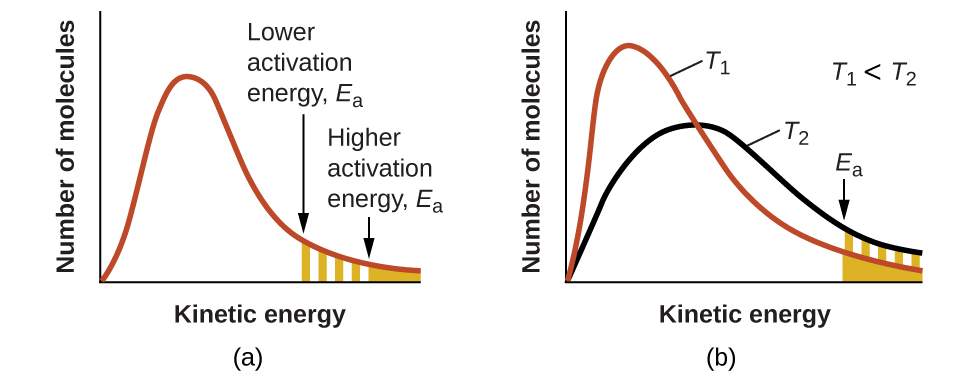
Why do reactions slow down at low temperatures? The collision model explains it. For a reaction to occur, reactant molecules must collide with sufficient energy and proper orientation to break bonds and form products.
Not all collisions lead to reaction. Only collisions with energy greater than the activation energy can successfully rearrange bonds. The Maxwell-Boltzmann distribution describes how many particles have each energy level. At higher temperatures, a larger fraction of molecules have energy exceeding the activation energy. This explains why reaction rates increase dramatically with temperature.
Orientation matters too. Two molecules might collide with enough energy, but if they're oriented poorly, the bonds won't rearrange correctly. The frequency of collisions depends on concentration and temperature. The energy and orientation requirements mean only a fraction of collisions are successful.
Key concepts to know:
- Collision model: Successful reactions require particles to collide with sufficient energy and correct orientation.
- Activation energy: The minimum energy required for a collision to produce a reaction.
- Maxwell-Boltzmann distribution: Shows how molecular energies are distributed. Higher temperature shifts the distribution right, increasing the fraction with energy above Ea.
- Collision frequency and energy: Both concentration and temperature affect the rate by influencing collision frequency and the fraction of energetic collisions.
โ Watch out for:
The Maxwell-Boltzmann distribution is used qualitatively, not for calculations. Use it to explain why temperature affects reaction rate, not to calculate exact fractions of molecules with sufficient energy.
๐ง Practice with StarSpark
๐ Flashcards ยท 15 cards
Topic
AP Chemistry: Collision Model and Activation Energy
Focus on
Activation energy, molecular orientation, Maxwell-Boltzmann distribution, temperature effects
๐ Quiz ยท 10 questions
Topic
AP Chemistry: Collision Model and Activation Energy
Description
Explaining temperature effects using collision model, relating activation energy to rate
Try these in StarSpark โ Flashcards or New Assignment
Topic 5.6: Reaction Energy Profile
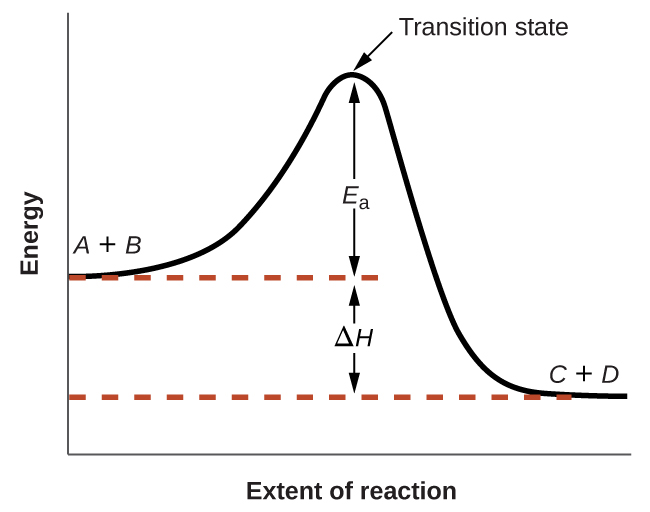
A reaction energy profile (also called a reaction coordinate diagram) is a graph showing energy as you progress along the reaction pathway. It reveals activation energy and whether the reaction is exothermic or endothermic.
On the x-axis is the "reaction coordinate," representing the progress of the reaction from reactants to products. On the y-axis is energy. The curve starts at the energy of reactants and ends at the energy of products. Along the way, it climbs to a peak representing the transition state, the highest-energy point in the reaction pathway.
The difference between the reactant energy and the transition state energy is the activation energy (Ea) for the forward reaction. If products have lower energy than reactants, the reaction is exothermic (negative ฮH). If products have higher energy, it's endothermic (positive ฮH).
Key concepts to know:
- Reaction energy profile: Shows energy versus reaction progress from reactants through transition state to products.
- Activation energy (Ea): The energy barrier that must be overcome. Higher Ea means slower reaction.
- Transition state: The highest-energy point on the reaction pathway where bonds are partially broken and formed.
- Temperature dependence: A given temperature determines what fraction of molecules have enough energy to reach the activation energy, controlling reaction rate.
โ Watch out for:
The Arrhenius equation calculations are not assessed on the AP exam. Focus on interpreting profiles and understanding how activation energy affects rate, not on calculating rate constants from the equation.
๐ง Practice with StarSpark
๐ Flashcards ยท 15 cards
Topic
AP Chemistry: Reaction Energy Profiles
Focus on
Reading energy profiles, identifying activation energy and enthalpy change, transition states
๐ Quiz ยท 10 questions
Topic
AP Chemistry: Reaction Energy Profiles
Description
Interpreting reaction energy profiles, relating Ea to reaction rate and temperature
Try these in StarSpark โ Flashcards or New Assignment
Topic 5.7: Introduction to Reaction Mechanisms
Most reactions don't happen in a single step. A reaction mechanism is a sequence of elementary reactions that, when added together, gives the overall balanced equation. Mechanisms reveal the molecular-level reality of how reactions proceed.
A reaction intermediate is a substance produced in one elementary step and consumed in another. Intermediates appear in the mechanism but not in the overall equation. Catalysts also appear in mechanisms, unchanged at the end. They're consumed in one step and regenerated later.
The elementary steps must add up to match the overall equation exactly. Any species that appears in an intermediate step but cancels out in the sum is not part of the final equation. A mechanism is valid only if it reproduces the overall stoichiometry.
Key concepts to know:
- Reaction mechanism: A sequence of elementary reactions that sum to the overall reaction.
- Intermediates: Produced and then consumed within the mechanism, not in the overall equation.
- Catalysts: Appear in the mechanism unchanged, speeding the reaction without being consumed overall.
- Elementary steps alignment: The sum of all steps must match the balanced overall equation.
โ Watch out for:
Make sure your mechanism adds up correctly. Cancel out intermediates and catalysts to confirm the sum matches the overall equation. If it doesn't match, your mechanism is invalid.
๐ง Practice with StarSpark
๐ Flashcards ยท 15 cards
Topic
AP Chemistry: Reaction Mechanisms and Intermediates
Focus on
Elementary steps, intermediates, catalysts, adding up mechanisms to overall equations
๐ Quiz ยท 10 questions
Topic
AP Chemistry: Reaction Mechanisms and Intermediates
Description
Identifying intermediates and catalysts, verifying mechanisms, connecting mechanisms to stoichiometry
Try these in StarSpark โ Flashcards or New Assignment
Topic 5.8: Reaction Mechanism and Rate Law
Here's where mechanism and kinetics connect. The rate law for a multi-step reaction is determined by the rate-limiting step, the slowest elementary step. When the first step is rate-limiting, the rate law follows directly from that step's stoichiometry.
If a mechanism has steps 1, 2, and 3 with step 1 being slowest, the overall rate law depends only on the reactants and products of step 1. Subsequent steps are fast, so they don't limit the overall speed. The rate-limiting step acts like a bottleneck.
This is why the rate law can't be predicted from the balanced equation alone. The mechanism must be determined experimentally (or given to you), and the rate-limiting step determines the kinetics.
Key concepts to know:
- Rate-limiting step: The slowest elementary step controls the overall reaction rate.
- Rate law from mechanism: When the first step is rate-limiting, the rate law matches the stoichiometry of that step.
- Limiting step bottleneck: Fast steps after the rate-limiting step don't affect the overall rate.
โ Watch out for:
Only when the first step is rate-limiting can you write the rate law directly from stoichiometry. If the first step is not rate-limiting, you need pre-equilibrium approximations, which are more complex.
๐ง Practice with StarSpark
๐ Flashcards ยท 15 cards
Topic
AP Chemistry: Rate Laws from Mechanisms
Focus on
Identifying rate-limiting steps, deriving rate laws from mechanisms, understanding bottlenecks
๐ Quiz ยท 10 questions
Topic
AP Chemistry: Rate Laws from Mechanisms
Description
Connecting mechanisms to rate laws, writing rate laws from rate-limiting steps
Try these in StarSpark โ Flashcards or New Assignment
Topic 5.9: Pre-Equilibrium Approximation
When the first elementary step is not rate-limiting, deriving the rate law is more complex. This is where the pre-equilibrium approximation comes in. If the first step is fast and reversible, it reaches a quasi-equilibrium before the slow step consumes products from the first step.
You can use the equilibrium constant for the first step to relate forward and reverse rates. Then use this relationship to eliminate intermediate concentrations from the rate law. The result is a rate law in terms of the original reactants and products, not intermediates.
This technique is more advanced and requires careful algebra, but it allows you to predict complex rate laws from mechanisms where early steps are fast.
Key concepts to know:
- Pre-equilibrium approximation: Used when an early fast step reaches equilibrium before a slower step.
- Equilibrium constant for fast steps: Relates the concentrations of reactants and products of the fast step.
- Eliminating intermediates: Use equilibrium relationships to express intermediate concentrations in terms of measurable species.
โ Watch out for:
The pre-equilibrium approximation is conceptually important but algebraically tricky. Practice carefully with problems where you apply the equilibrium expression to eliminate intermediates.
๐ง Practice with StarSpark
๐ Flashcards ยท 15 cards
Topic
AP Chemistry: Pre-Equilibrium Approximation
Focus on
Applying equilibrium to fast steps, eliminating intermediates, complex rate laws
๐ Quiz ยท 10 questions
Topic
AP Chemistry: Pre-Equilibrium Approximation
Description
Using pre-equilibrium to derive rate laws, solving for overall rate expressions
Try these in StarSpark โ Flashcards or New Assignment
Topic 5.10: Multistep Reaction Energy Profile
For reactions with multiple elementary steps, you can draw an energy profile showing the energy for each step. Each step has its own activation energy and produces intermediates at varying energy levels.
The overall activation energy of the reaction is the height from reactants to the highest transition state encountered. The overall enthalpy change is the difference between final product energy and initial reactant energy. Intermediates appear as peaks and valleys between steps.
A well-designed mechanism has the rate-limiting step's transition state as the highest point. If a later step has a higher transition state, it would be rate-limiting instead.
Key concepts to know:
- Multistep energy profiles: Show activation energies for each elementary step and the energy of intermediates.
- Overall activation energy: From reactants to the highest transition state in the mechanism.
- Rate-limiting step identification: The step with the highest transition state controls the overall rate.
- Intermediate energy levels: Intermediates appear between steps at varying heights depending on their stability.
โ Watch out for:
On a multistep profile, the overall Ea is from reactants to the highest transition state, not just the first step's activation energy. Make sure you identify which transition state is tallest.
๐ง Practice with StarSpark
๐ Flashcards ยท 15 cards
Topic
AP Chemistry: Multistep Reaction Energy Profiles
Focus on
Reading multistep profiles, identifying rate-limiting steps, interpreting intermediate energies
๐ Quiz ยท 10 questions
Topic
AP Chemistry: Multistep Reaction Energy Profiles
Description
Interpreting profiles for multistep reactions, connecting mechanisms to energies
Try these in StarSpark โ Flashcards or New Assignment
Topic 5.11: Catalysis
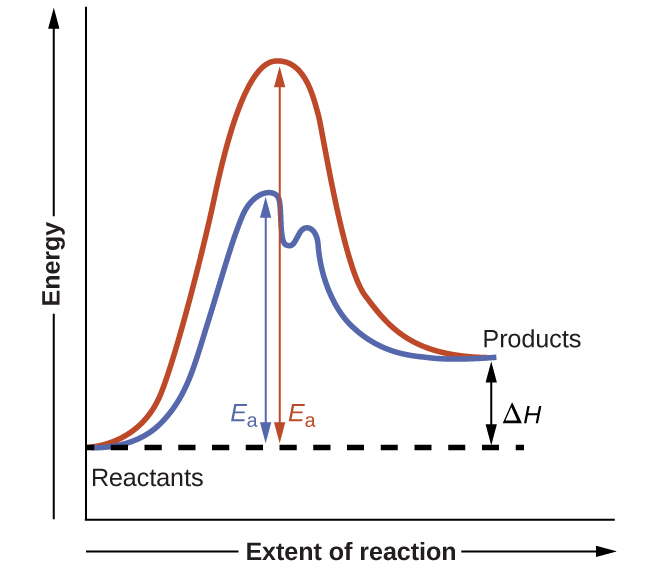
A catalyst is a substance that increases reaction rate without being consumed. Catalysts work by providing an alternative reaction pathway with a lower activation energy. By lowering the energy barrier, more molecules have sufficient energy to react, speeding up the reaction dramatically.
Catalysts appear in reaction mechanisms. They're consumed in an early step and regenerated in a later step, so they don't appear in the overall equation. This is how you identify them in mechanisms.
Some catalysts work by binding to reactants, orienting them for favorable reaction or reducing the activation energy. Others, like acid-base catalysts, transfer a proton to the reactant, creating an intermediate with lower activation energy. Some catalysts bind to surfaces, allowing reactants to meet at favorable orientations and react faster. In all cases, the catalyst speeds the reaction without being permanently changed.
Key concepts to know:
- Catalyst function: Lowers activation energy by providing an alternative pathway.
- Mechanism appearance: Consumed early, regenerated later. Not in the overall equation.
- Binding and orientation: Some catalysts bind reactants, orienting them or reducing Ea for the new reaction pathway.
- Acid-base catalysis: A reactant or intermediate gains or loses a proton from a catalytic species.
- Surface catalysis: Reactants bind to a surface, facilitating reaction at the surface.
โ Watch out for:
Catalysts don't change the overall energy difference between reactants and products. They only lower the activation energy. So they speed up both forward and reverse reactions equally.
๐ง Practice with StarSpark
๐ Flashcards ยท 15 cards
Topic
AP Chemistry: Catalysis and Catalysts
Focus on
How catalysts lower Ea, identifying catalysts in mechanisms, types of catalysis
๐ Quiz ยท 10 questions
Topic
AP Chemistry: Catalysis and Catalysts
Description
Understanding catalyst mechanisms, explaining catalyst effects on energy profiles
Try these in StarSpark โ Flashcards or New Assignment
Study Tips for Unit 5
Kinetics is all about patterns and relationships. Master these habits:
- Memorize the graphing rules. Zeroth order: [A] vs. t is linear. First order: ln[A] vs. t is linear. Second order: 1/[A] vs. t is linear. Knowing these by heart saves time.
- Practice determining order from initial rate data. Compare rates when you change concentration. If rate doubles when concentration doubles, that's first order.
- Draw energy profiles for mechanisms. Visualizing the steps helps you spot the rate-limiting step and understand how catalysts lower the barrier.
- Check mechanisms by adding them up. Write out each step, then cross off anything that appears as both product and reactant. If the sum doesn't match the overall equation, the mechanism is wrong.
- Connect mechanisms to rate laws. Remember: first step rate-limiting means rate law follows from that step. Otherwise, use pre-equilibrium.
- Understand why temperature matters. Use Maxwell-Boltzmann distribution reasoning. More molecules have Ea at higher T.
Summary, Review Questions & Practice
You've covered all the topics in Unit 5: from reaction rates and rate laws to mechanisms, activation energy, and catalysts. You understand how reactions work at the molecular level and can predict how conditions affect speed. Before you move on, test yourself with these scenario-based questions. If you can answer them confidently, you're ready for the next unit.
Review Questions: Test Yourself
- For the reaction A + B โ C, experimental data shows that when [A] is doubled while [B] stays constant, the rate increases by a factor of 4. When [B] is doubled while [A] stays constant, the rate doubles. Write the rate law and identify the overall order.
- A reaction with a large negative ฮG can still be slow at room temperature. Using collision model and activation energy concepts, explain why. How would increasing temperature affect the rate?
- Given the mechanism: (slow) A + A โ A2, (fast) A2 + B โ A2B, derive the rate law and explain how you identified the rate constant and reaction orders.
- A catalyst is added to a reaction. Explain how it affects the activation energy, the rate constant, the equilibrium constant, and the overall ฮG. Which of these does the catalyst actually change?
- For a first-order reaction, the half-life is 30 minutes. After 90 minutes, what fraction of the original reactant remains? Show your reasoning.
Want more practice? Paste these questions into StarSpark to generate a full quiz with explanations.
Explore the Full AP Chemistry Study Guide
Unit 5 teaches you to think like a kinetics expert. You now understand why reactions happen at different speeds and how to control them. This foundation is essential for thermodynamics and all practical chemistry applications.
Check out the full AP Chemistry study plan to see how this unit connects to the rest of the course.
Other Unit Reviews:
- AP Chemistry Unit 1: Atomic Structure and Properties
- AP Chemistry Unit 2: Compound Structure and Properties
- AP Chemistry Unit 3: Properties of Substances and Mixtures
- AP Chemistry Unit 4: Chemical Reactions
- AP Chemistry Unit 6: Thermochemistry
- AP Chemistry Unit 7: Equilibrium
- AP Chemistry Unit 8: Acids and Bases
- AP Chemistry Unit 9: Thermodynamics and Electrochemistry
For official AP Chemistry resources, visit apcentral.collegeboard.org.
This review is aligned with the AP Chemistry Course and Exam Description. AP is a registered trademark of the College Board, which was not involved in the production of this guide.