
Chemical reactions are everywhere. When you burn wood, digest food, or create a battery, chemical reactions are at work. Unit 4 is where you learn to identify, represent, and understand the transformations that matter undergoes. You'll master the language of chemistry by writing equations that show exactly what's happening at the molecular level.
Unit 4 makes up about 7-9% of the AP Chemistry exam. Focus your energy on these priorities:
What's in this review:
Matter changes constantly. Sometimes it's just a change in appearance or state. Other times, the substance itself transforms into something completely new. Learning to distinguish between these two types of changes is your first step to understanding chemistry.
A physical change is when matter changes its properties but not its composition. When ice melts into water, you've got a physical change. The water molecules are still H2O, but they've rearranged from a solid to a liquid. Phase changes, dissolving a salt in water, and breaking a rock into smaller pieces are all physical changes. The substance remains fundamentally the same.
A chemical change is different. Here, substances are transformed into new substances with different compositions. When wood burns, it reacts with oxygen to form carbon dioxide and water. The original molecules are gone. You can observe chemical changes through evidence like heat release, light production, gas formation, precipitate formation, or color change.
Key concepts to know:
⚠ Watch out for:
Not all phase changes are purely physical. Dissolving a salt in water, for instance, breaks ionic bonds. While it's typically classified as a physical change, strong arguments could be made that it's chemical because bonds are broken. Focus on the most common classification, but know that edge cases exist.
Writing a balanced equation is like writing a sentence in the language of chemistry. It tells you exactly what's reacting, what's being produced, and in what proportions. But different equations can represent the same reaction in different ways.
A balanced chemical equation shows all reactants and products, with coefficients that ensure the number of each type of atom is the same on both sides. This respects the law of conservation of mass. For ionic compounds in aqueous solution, you can write a complete ionic equation that shows all ions present, including spectator ions (ions that don't participate). Then comes the net ionic equation, which removes spectator ions and shows only the species that actually react.
For example, when silver nitrate and sodium chloride react, you get a precipitation reaction. The complete ionic equation shows all ions. But the net ionic equation removes the spectator ions (Na+ and NO3-) and shows just what matters: Ag+ combining with Cl- to form AgCl solid.
Key concepts to know:
⚠ Watch out for:
Students often forget to balance charges in ionic equations. You must balance both atoms AND charge. Also, make sure you correctly identify spectator ions. An ion that appears on both sides of the complete ionic equation is a spectator and gets removed.
Chemistry has a visual language. You can represent the same reaction in different ways: words, chemical equations, or particulate diagrams. Each representation gives you a different view of what's happening.
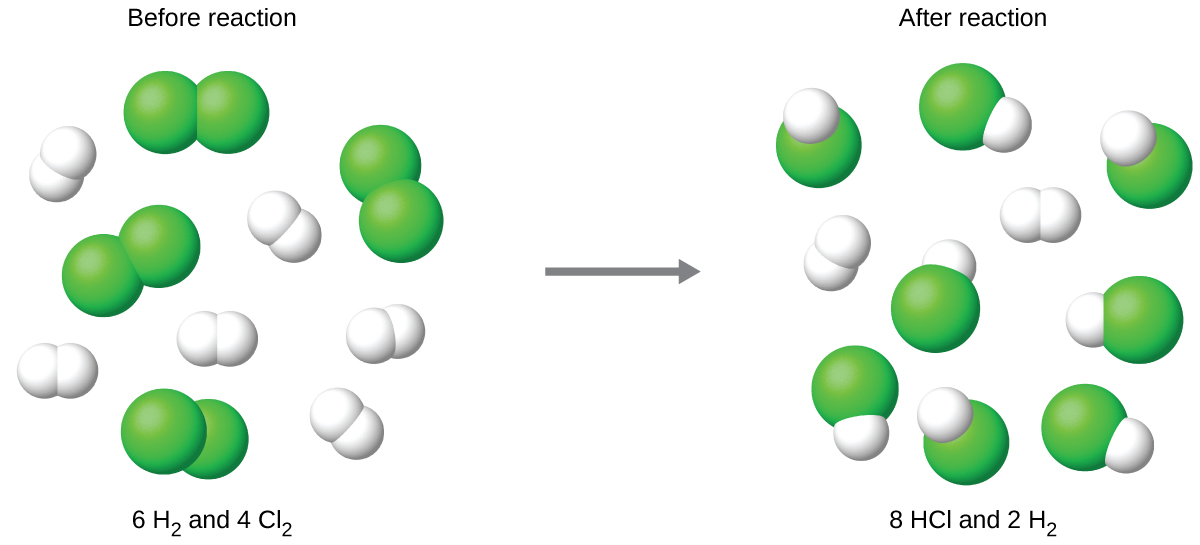
A particulate model shows individual atoms and molecules before and after a reaction. This visual representation makes it clear how atoms rearrange. When you see a particulate diagram, count the atoms before and after to verify the equation is balanced. The beauty of particulate models is that they bridge the gap between the equation on paper and the actual molecular reality of the reaction.
Balanced chemical equations translate directly into particulate representations. If your equation shows 2 H2 + O2 → 2 H2O, your particulate diagram should show 2 hydrogen molecules and 1 oxygen molecule on the reactant side, and 2 water molecules on the product side.
Key concepts to know:
⚠ Watch out for:
When converting between particulate diagrams and equations, make sure your coefficients match what you see in the diagram. If a diagram shows 3 molecules of something, your coefficient should be 3. Misreading the diagram is a common mistake.
Chemistry lives at the molecular level. When you understand what's happening to bonds and interactions, you understand why reactions behave the way they do.
In chemical processes, bonds are broken and new ones form. When methane burns, C-H and C-C bonds break, and new C=O and O-H bonds form. These chemical changes involve reorganizing atoms into new combinations. In physical processes, like dissolving sugar in water, intermolecular interactions change, but covalent bonds within molecules usually stay intact. Phase changes are the classic physical process: solid to liquid to gas involves breaking intermolecular forces, not covalent bonds.
But here's where it gets tricky. Dissolving a salt in water breaks ionic bonds but forms ion-dipole interactions. Is this chemical or physical? Most chemists classify it as physical, but the CED notes that you could argue either way. Know that the distinction comes down to whether the substance fundamentally changes composition. A salt ion is still Na+ and Cl-, just surrounded by water molecules.
Key concepts to know:
⚠ Watch out for:
The distinction between physical and chemical changes at the molecular level isn't always black and white. Focus on the most common cases: breaking covalent bonds is chemical, breaking intermolecular forces is physical. Don't overthink edge cases.
Stoichiometry is where chemistry becomes a calculation. The coefficients in a balanced equation tell you the proportions of substances involved. Use these proportions to predict how much product forms or how much reactant you need.
The power of stoichiometry is that it connects the balanced equation to real quantities. If you know you have 5 moles of one reactant, you can calculate how many moles of product will form. The coefficients in the equation are the conversion factors. A 2:1 ratio in the equation becomes a 2:1 mole ratio.
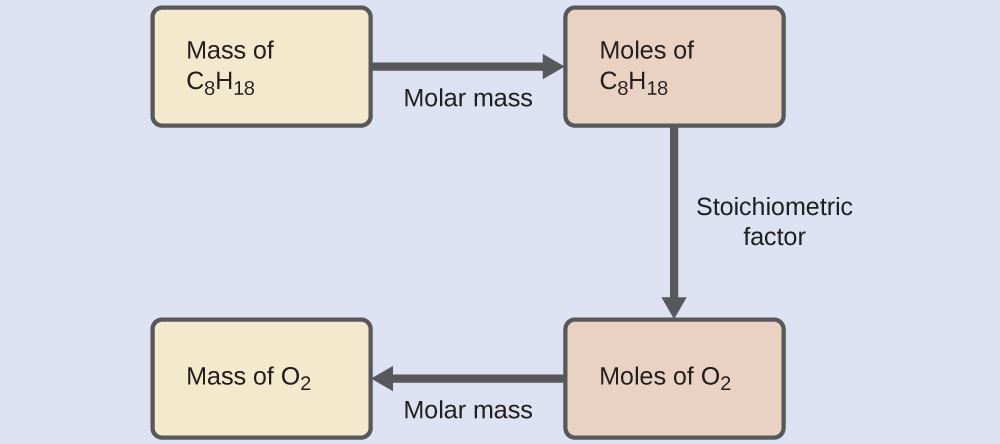
Stoichiometric calculations can be combined with the ideal gas law, molarity calculations, or density to solve complex problems. For example, if you're given the mass of one reactant, convert to moles using molar mass, use stoichiometry to find moles of product, then convert back to mass. Each step follows logically from the one before.
Key concepts to know:
⚠ Watch out for:
Always make sure you're using the balanced equation's coefficients as mole ratios. A common mistake is using the wrong coefficients or flipping the ratio. Also, in multi-step problems, don't round intermediate answers. Carry extra significant figures through calculations, then round at the end.
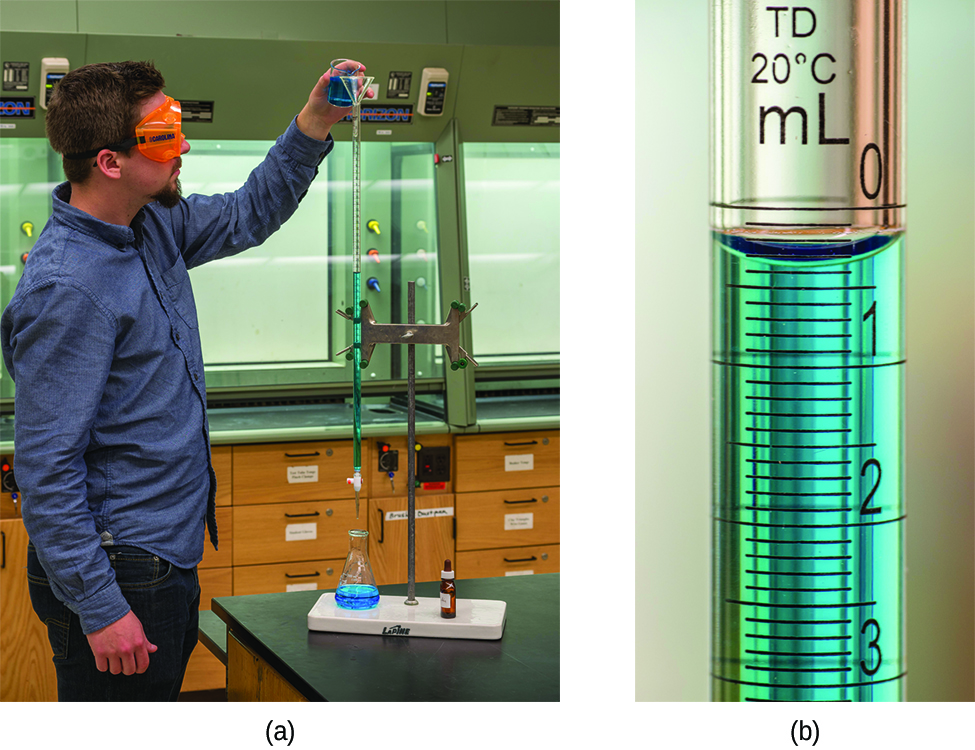
Titration is one of the most important techniques in analytical chemistry. It's how you determine the concentration of an unknown substance by reacting it with a known substance. The reaction must be specific and quantitative, meaning it goes to completion with a predictable stoichiometry.
In a titration, you add a liquid of known concentration (the titrant) to a sample of unknown concentration (the analyte) until the reaction is complete. The key is finding the equivalence point, where the amount of titrant added equals exactly the amount needed to react with all the analyte. The endpoint is when you observe a visible change (usually a color change) that signals you've reached the equivalence point.
The goal is to use the volume of titrant needed to reach the endpoint to calculate the concentration of the unknown analyte. Because you know the stoichiometry of the reaction, you can work backwards from the moles of titrant to moles of analyte, then to concentration.
Key concepts to know:
⚠ Watch out for:
Don't confuse equivalence point and endpoint. The equivalence point is theoretical (when moles are exactly balanced). The endpoint is observable (a color change or other indicator). They should be very close but aren't always exactly the same.
Not all chemical reactions are the same. Knowing what type of reaction you're looking at helps you predict products and understand what's happening. The exam tests three main types: acid-base, oxidation-reduction (redox), and precipitation.
Acid-base reactions involve the transfer of protons (H+ ions) between species. An acid donates a proton, and a base accepts one. When hydrochloric acid reacts with sodium hydroxide, H+ moves from HCl to OH-, forming water.
Redox reactions involve the transfer of electrons between reactants. In these reactions, one substance is oxidized (loses electrons) and another is reduced (gains electrons). Combustion is an important type of redox reaction where a substance reacts with oxygen gas. When methane burns completely, it produces carbon dioxide and water.
Precipitation reactions occur when ions combine in aqueous solution to form an insoluble solid. When aqueous silver nitrate is mixed with aqueous sodium chloride, the Ag+ and Cl- ions combine to form a white precipitate of silver chloride. Some salts are always soluble. All sodium, potassium, ammonium, and nitrate salts are soluble in water.
Key concepts to know:
⚠ Watch out for:
Don't try to memorize solubility rules beyond sodium, potassium, ammonium, and nitrate. The exam only requires knowing these four. If you see a salt with one of these ions, it's soluble. Don't get bogged down in "bromide is usually soluble except..." details.
Acids and bases are among the most important substances in chemistry and biology. The Brønsted-Lowry definition gives you the key: an acid is a proton donor, and a base is a proton acceptor.
When an acid and base react, they form a conjugate acid-base pair. The acid transfers a proton to the base. After the transfer, the acid becomes its conjugate base (a species that can accept a proton back), and the base becomes its conjugate acid (a species that can donate a proton).
Water plays a special role in aqueous solutions. Water can donate a proton (acting as an acid) or accept a proton (acting as a base). This amphoteric nature is why water is the solvent for most acid-base chemistry.
Key concepts to know:
⚠ Watch out for:
The Lewis acid-base definition is NOT on the AP exam. Stick with Brønsted-Lowry (proton transfer). Also, conjugate pairs differ by exactly one proton. HCl and Cl- are conjugate, but HCl and Cl2 are not.
Redox reactions are all about electrons. In these reactions, electrons transfer from one substance to another. One substance is oxidized (loses electrons), and another is reduced (gains electrons). These reactions power batteries, fuel cells, and countless biological processes.
To track electron movement, chemists use oxidation numbers. These are assigned values that represent the number of electrons lost or gained by an atom. The rules for assigning oxidation numbers are consistent, which lets you identify which atoms are oxidized and reduced in a reaction.
A half-reaction shows just the oxidation part or just the reduction part. By writing half-reactions separately, you can balance the electrons carefully. The electrons lost by one species must equal the electrons gained by the other. Once balanced, you add the half-reactions to get the overall balanced redox equation.
Key concepts to know:
⚠ Watch out for:
The terms "reducing agent" and "oxidizing agent" are not assessed on the AP exam, so don't worry about those labels. Focus on identifying what's oxidized and reduced using oxidation numbers. Also, when balancing half-reactions, be careful with acidic versus basic conditions, though the exam typically gives you hints.
Unit 4 is all about translation and representation. Your biggest tool here is practice:
You've covered all the topics in Unit 4: from identifying physical and chemical changes to writing net ionic equations, using stoichiometry to solve problems, identifying reaction types, and balancing redox equations. Before you move on, test yourself with these scenario-based questions. If you can answer them confidently, you're in great shape for this section of the exam.
Review Questions: Test Yourself
Want more practice? Paste these questions into StarSpark to generate a full quiz with explanations.
Unit 4 is your foundation for everything that follows. Once you can write balanced equations, identify reaction types, and use stoichiometry confidently, you're ready to dive deeper into kinetics, thermochemistry, and beyond.
Check out the full AP Chemistry study plan to see how this unit connects to the rest of the course.
Other Unit Reviews:
For official AP Chemistry resources, visit apcentral.collegeboard.org.
This review is aligned with the AP Chemistry Course and Exam Description. AP is a registered trademark of the College Board, which was not involved in the production of this guide.
Start learning with StarSpark today.
Free for 14 days, no credit card needed.