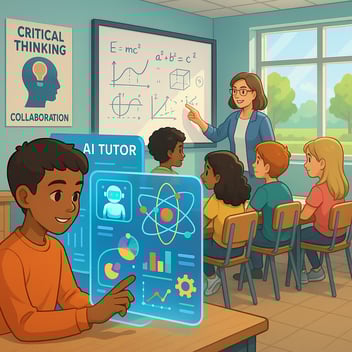



AI is no longer an abstract idea in K–12 education. It is already influencing how students approach assignments, how teachers plan lessons, and how learning happens beyond the classroom.
For educators, the question has shifted. It is no longer whether AI belongs in schools. It is how to use AI in ways that support instruction, preserve rigor, and genuinely help students learn.
When implemented thoughtfully, AI can be a powerful instructional support. When implemented poorly, it can undermine the very learning it is meant to improve. The difference lies in design, intent, and alignment with how teaching and learning actually work

Why classrooms are ready for instructional AI
Most educators recognize a familiar set of challenges: Wide variation in student readiness within a single classroom
-
Limited time for individualized feedback
-
Pressure to maintain rigor while supporting diverse learning needs
-
Increasing expectations without proportional increases in resources
These are not new problems. What is new is the possibility of using AI to help address them without sacrificing instructional quality.
When designed for classrooms, AI can extend a teacher’s reach, not replace it. It can help ensure that more students receive timely guidance while teachers focus on instruction, discussion, and relationship-building.
Where AI adds real instructional value
AI is most effective in schools when it focuses on supporting teaching, not automating it.
Differentiated support without fragmentation
Instructional AI can adjust practice and explanations based on student understanding while keeping learning goals consistent across a classroom. This allows students to work at an appropriate pace without lowering expectations or creating separate instructional tracks.
More opportunities for practice and feedback
Learning requires practice and feedback. AI can provide guided feedback during independent work, helping students stay engaged and productive while teachers concentrate on higher-level instructional tasks.
Greater visibility into student thinking
Well-designed AI tools surface patterns in student understanding and misconceptions. This gives teachers actionable insight into where students are struggling or progressing without adding more grading or administrative burden.
Instructional continuity beyond the classroom
AI can support students outside of class time in ways that remain aligned with classroom instruction. This reinforces learning rather than pulling students in unrelated directions.
Positive impact on students
When instructional AI is implemented thoughtfully, students benefit in ways that go beyond convenience.
Students gain:
-
More chances to practice with guidance
-
Explanations that adapt to their level of understanding
-
Support that encourages reasoning rather than shortcuts
-
Increased confidence as concepts become clearer
For students who need additional time or alternative explanations, AI can provide consistent support without stigma. For advanced students, it can offer opportunities to deepen understanding.
How StarSpark supports schools and educators
StarSpark was built specifically for math instruction, with the realities of classrooms in mind.
Rather than functioning as a general-purpose chatbot, StarSpark operates as an AI math teacher within a structured instructional system. Instruction and practice are aligned to Common Core and state standards. Students are guided through reasoning step by step, and practice adapts based on mastery and understanding.
Equally important, learning remains visible. Teachers and schools can see progress, gaps, and growth across students. This ensures that AI supports instruction rather than operating outside it.
StarSpark is designed to work alongside teachers, reinforcing classroom learning and helping students build understanding over time.
Benefits for schools and districts
At the school and district level, instructional AI offers benefits that extend beyond individual classrooms.
When implemented responsibly, AI can:
-
Improve instructional consistency across classrooms
-
Support equity by providing reliable access to high-quality explanations
-
Reduce teacher workload without lowering expectations
-
Provide data that informs instructional decisions
-
Scale support without increasing staffing demands
The goal is not efficiency for its own sake. It is better to have learning outcomes supported by sustainable teaching practices.
Why pilots matter before adoption
Educational technology should be evaluated in real classrooms, not through feature lists or marketing demonstrations.
That is why StarSpark offers free school pilot programs. Pilots allow educators and administrators to see how instructional AI fits within their curriculum, teaching approach, and student needs.
During a pilot, schools can:
-
Observe how students engage with guided math instruction
-
Evaluate alignment to standards and instructional goals
-
Assess impact on understanding and engagement
-
Make informed decisions without long-term commitment
Looking ahead
AI will continue to evolve. The schools that benefit most will not be those that adopt it quickly, but those that adopt it thoughtfully.
When AI is designed to support teaching, reinforce curriculum, and help students think more deeply, it can strengthen classrooms rather than disrupt them.
For educators, the goal is not to change how they teach.
It is to gain tools that help them teach more effectively, with greater reach and less friction.
That is the promise of instructional AI done right.